
Introduction
You open the bathroom closet at 7 a.m., and a bottle of conditioner falls out. The towels are jammed in sideways. You can't find the spare soap you know is in there somewhere — probably buried behind three half-empty bottles of shampoo.
Sound familiar? A cluttered bathroom closet is one of those daily friction points that seems minor until it isn't. The fix isn't buying more storage bins and hoping for the best. It's choosing the right shelving approach for your space, then organizing it in a way that sticks.
This guide covers 14 practical shelving ideas — from quick wins like over-the-door organizers to long-term solutions like custom built-ins — plus organization tips to keep any system running long-term.
Key Takeaways
- Your closet's size and depth should drive your shelving choice — no single solution works for every space
- Vertical space is almost always wasted; floor-to-ceiling systems reclaim it
- Grouping by category and labeling bins keeps systems maintainable in shared bathrooms
- Bathroom humidity affects what materials last — choose accordingly
- Custom built-in shelving fits your exact dimensions, maximizing every inch a standard system leaves behind
Before You Organize: Start With a Clean Slate
Before buying a single shelf or bin, pull everything out of the closet. Discard expired products, consolidate duplicates, and assess what truly needs to live in the bathroom versus a hallway closet or linen cabinet elsewhere.
This step matters more than most people expect. Organizing around items you don't need just creates a tidier version of the same problem.
Measure First, Buy Second
Once you know what you're storing, measure the closet carefully:
- Floor-to-ceiling height tells you whether stackable or vertical systems are even feasible
- Usable wall length sets the maximum width for any shelving run
- Depth determines whether standard 12-inch shelves work, or whether you'll need pull-outs to reach the back
Lowe's installation guidance recommends measuring all three dimensions before planning any shelving layout. Skipping this step often means buying a system that won't fit and starting over.
14 Bathroom Closet Shelving Ideas
1. Adjustable Solid or Wire Shelving
Wall-mounted track systems with adjustable shelves are one of the most versatile starting points. You can reposition shelves as your storage needs change — move them closer together for toiletry bins, spread them out when you need to accommodate taller bottles or folded towels.
ClosetMaid's wire shelving specifications rate their systems at 50 lbs per linear foot with standards 24 inches apart, or 100 lbs per linear foot when standards are placed 16 inches apart. These ratings are hardware-specific, so check the specs for whatever system you're installing.
2. Floor-to-Ceiling Cubbies
Cubby systems that run from floor to ceiling make use of every inch of vertical space and keep items visually separated by category. Some configurations include small doors that conceal bulkier or less attractive items — cleaning supplies, hair tools, backup stock — while leaving frequently used items accessible.
3. Pull-Out Drawers and Slide-Out Bins
Deep bathroom closets are genuinely hard to use. Items at the back get forgotten; you end up buying duplicates of things you already own. Pull-out drawer inserts solve this — slide them out and everything at the back is immediately accessible. They work especially well for hairdryers, first-aid supplies, and toiletry backstock.
4. Lazy Susan Turntable Shelves
A rotating turntable on a shelf is a simple fix for the "deep shelf" problem. One spin brings everything to the front. Particularly useful for bottles, sprays, and small containers that tend to get lost behind taller items.
5. Over-the-Door Organizer
The back of the bathroom closet door is often completely ignored. An over-the-door rack or hanging organizer can hold frequently used items — toiletries, cleaning sprays, hair tools — without taking up any shelf space at all. According to Elfa's installation guides, the bottom hook should not press tightly against the door to avoid damage over time.
6. Floating Wall Shelves
Open floating shelves work well in smaller bathrooms or open-style closets where aesthetics matter. They're best suited for items that look neat when displayed: rolled towels, folded linens, or decorative baskets.
Screws driven into wall studs provide the best support — never rely on drywall anchors alone for shelves that will carry real weight.
7. Stackable Clear Bins and Containers
Clear bins let you see contents at a glance — the simplest fix for the "bought another one" problem. A few rules make them work:
- Stack bins to fill vertical space, sizing them to match your shelf height
- Group by category: hair care, first aid, and spare toiletries each get their own shelf
- Label bins on the front face, not the top, so contents are visible without moving anything
8. Basket-Organized Shelf System
Labeled woven or fabric baskets on each shelf keep the closet looking cohesive while corralling items by category. This approach works especially well when shelves are open and visible — baskets hide the visual clutter without hiding what's inside, as long as labels are consistent.
9. Over-the-Toilet Shelving Unit
Freestanding or wall-mounted shelving above the toilet uses dead vertical space that would otherwise go to waste. Easy access to toilet paper, spare towels, and small toiletries without sacrificing floor space — a practical option for bathrooms without a dedicated closet.
10. Recessed Built-In Wall Shelving
Recessed shelves are built into the wall cavity between studs, so they add storage without any protrusion into the room. In narrow bathrooms where floor space is precious, this can be the difference between a functional space and a cramped one.
The American Wood Council notes that exterior wall studs are typically 16 inches on center, though 24 inches is permitted in some one-story constructions. Always verify stud spacing and check for plumbing or wiring before cutting into any wall.
11. Double Hanging Rod System
Adding a second hanging rod below an existing one doubles hanging capacity for towels, robes, and toiletry bags. It's a low-effort upgrade that costs very little and works especially well in linen-style closets where folded items and hanging items coexist.
12. Under-Sink Storage with Pull-Outs
The cabinet space under the bathroom sink is some of the most wasted real estate in any home — mostly because the plumbing gets in the way. A few solutions work well around the pipes:
- Pull-out organizers mounted on the cabinet floor slide past the P-trap without modification
- Tiered risers create a second level on each side of the plumbing
- Small bins tucked around the pipes keep cleaning supplies and spare toiletries accessible
13. Three-Tier Multi-Level Wall Shelves
Three-tier wall-mounted units provide multiple storage levels within a compact wall footprint. A good option for small bathrooms that need storage but can't accommodate a full closet — they display items openly while keeping everything at arm's reach.
14. Custom Built-In Bathroom Closet System
Custom built-ins are the most efficient long-term solution because they're designed around the exact dimensions of your space. A mix of shelf heights, pull-out drawers, and designated storage zones eliminates the gaps and wasted corners that off-the-shelf systems leave behind. Materials can also be selected for bathroom conditions specifically — moisture-resistant options that hold up over time rather than warping or swelling.
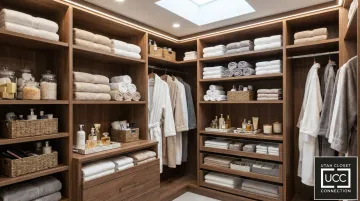
Utah Closet Connection designs and installs custom bathroom closet systems across Salt Lake County, Utah County, Davis County, Summit County, Weber County, and surrounding areas — backed by a lifetime workmanship warranty on every installation.
Organization Tips to Make Any Shelving System Work
The right shelving helps. But the organization system running on top of it determines whether things stay tidy six months from now.
Use the Zone Method
Divide shelving into dedicated areas by category and frequency of use:
- Eye level: Daily-use items — the things you reach for every morning
- Upper shelves: Backup stock, seasonal items, things you need monthly
- Middle shelves: Towels and linens
- Lower shelves: Cleaning products and bulkier items
This structure makes the closet intuitive for every household member, not just the person who organized it.
Label Everything in Shared Bathrooms
Labeling bins and baskets is the single most effective way to keep a shared bathroom closet from sliding back into chaos. When people know exactly where something goes, they put it back there. Without labels, every item becomes an independent decision — and the system quietly unravels.
Fold Towels Efficiently
Two approaches work well, depending on your setup:
- Fold in thirds, stack face-out — saves space and keeps shelves looking neat
- Roll and stand upright — works better in open baskets or cubbies, and lets you grab one towel without disturbing the rest
Do a Seasonal Audit
Set a reminder every season to spend 15 minutes on the closet. Remove expired products, restock essentials, and check whether the current layout is still working. Needs change — what worked when you set up the system may not fit 12 months later.
A quick seasonal check prevents gradual clutter buildup far better than waiting for a full reorganization.
What to Store (and What to Avoid) in a Bathroom Closet
Good Items to Store
- Extra towels and washcloths
- Toilet paper
- Toiletry backstock — shampoo, soap, lotion
- First aid supplies
- Cleaning products
- Hair tools and accessories
These items benefit from being close to where they're used, and most hold up well in bathroom humidity. Not everything does, though.
What Doesn't Belong in a Bathroom Closet
MedlinePlus warns that the heat and moisture from showers, baths, and sinks can damage medications — pills and capsules are especially vulnerable. Despite being called a "medicine cabinet," the bathroom is actually one of the worst places to store most medications.
Keep out:
- Medications — store in a cool, dry location instead
- Electronics — humidity accelerates corrosion
- Loose paper products — paper stored openly in a humid bathroom can absorb moisture and degrade
Material Matters
Bathrooms run at higher humidity than most rooms, particularly after showers. The Composite Panel Association's technical bulletin notes that moisture-resistant MDF should be used in bathroom applications to reduce thickness swell.
For shelving and cabinetry, these materials hold up best:
- PVC — fully moisture-proof, ideal for high-humidity spaces
- Melamine over moisture-resistant substrate — durable and easy to clean
- Sealed hardwood — holds up well when properly finished
- Moisture-resistant MDF — a solid mid-range option
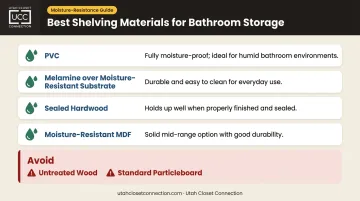
Avoid untreated wood and standard particleboard — both are prone to warping and swelling over time.
When to Consider a Custom Bathroom Closet Solution
Standard shelving handles typical closets fine. A few specific situations, though, call for a custom approach:
- Awkward dimensions that standard shelf widths can't fill
- Wasted corners with no way to access them
- A door that swings into the closet and blocks shelving placement
- Storage needs that have outgrown what generic systems can handle
Utah Closet Connection builds custom bathroom closet systems designed to the exact dimensions of a homeowner's space — with adjustable shelving, pull-out drawers, and designated zones that eliminate the guesswork. The team serves homeowners across Salt Lake County, Utah County, Davis County, Summit County, and Weber County, Utah. Reach them at (801) 939-3088, Monday through Thursday, 9 AM to 4 PM.
Frequently Asked Questions
What are some good shelving ideas for a bathroom?
Adjustable wall-mounted shelving, stackable clear bins, over-the-door organizers, and floating shelves are all practical starting points. The best choice depends on your closet's depth, height, and what you're storing most — there's no universal answer.
What should not be stored in a bathroom?
Medications should stay out — heat and humidity degrade pills and capsules over time. Electronics and loosely stored paper products are also poor candidates for bathroom storage due to moisture exposure.
How far apart should shelves be in a bathroom closet?
Shelf spacing should be based on what you're storing. Measure your tallest items and add an inch or two of clearance. Folded towels and toiletry bins need less vertical room than rolled towels or tall cleaning bottles — adjustable shelving makes it easy to reconfigure as your needs shift.
How do I organize a small bathroom closet with limited space?
Go vertical with stackable bins and tiered risers, add an over-the-door organizer, and keep only current-use items inside. Extra paper products and spare toiletries store better in a hallway closet or bedroom shelf where humidity isn't a factor.
What material is best for bathroom closet shelves?
Moisture-resistant options hold up best: coated MDF, PVC, melamine over moisture-resistant substrates, or sealed hardwood. Untreated wood and standard particleboard are prone to warping and swelling when exposed to bathroom humidity.
How do I keep my bathroom closet organized long-term?
Label every bin and basket, assign a designated zone for each category of item, and do a quick seasonal audit to remove expired products and reassess whether the layout still fits your needs. The simpler the system, the more likely it is to stick.