

Introduction
Around 1900, a young San Franciscan named William Lawrence Murphy faced a problem familiar to city dwellers across every era: too little space, too much furniture, and a social life that demanded both. His solution — folding his bed into the wall — gave rise to one of the most enduring furniture inventions in American history.
What started as a courtship strategy eventually became a commercial product, a legal landmark, and a slapstick comedy staple — common enough by the mid-20th century that courts stripped the name of its trademark protection. Over 120 years later, the Murphy bed still solves the same problem it was built to solve.
This article covers who William Murphy was, how his invention spread from San Francisco apartments to New York City real estate listings, how a U.S. court stripped the name of its trademark protection, and how the design has transformed from a basic hinged frame into a range of sophisticated configurations.
Key Takeaways
- William Lawrence Murphy invented the "Disappearing Bed" around the turn of the 20th century in San Francisco, driven by a practical (and personal) space problem in his apartment
- His verified patents span 1912 (the "Disappearing Bed," US1030201A) and 1916 (design patent USD49273S)
- The Murphy Bed Company had established a New York operation by the mid-1920s, with 1920s apartment ads using the bed as a selling point
- In 1989, the U.S. Court of Appeals for the Second Circuit ruled "Murphy bed" a generic term — meaning any wall bed can legally carry that name today
- Modern versions come in twin, full, queen, and king sizes across five distinct styles, making them viable for guest rooms, studios, and home offices alike
What Is a Murphy Bed?
A Murphy bed is a bed hinged at one end that folds vertically up against a wall or into a cabinet when not in use. The terms wall bed, pull-down bed, and fold-down bed all describe the same mechanism. Since 1989, "Murphy bed" has been a generic term — no longer tied to any single manufacturer.
A Long History of Hidden Beds
Folding beds predate Murphy by centuries. A New York Times reference from 1982 documents "bureau bedsteads" — beds disguised as bureaus with a hinged frame that folded up, closing to resemble a cabinet — with references reaching back to 1785. The concept of hiding a bed was already well established.
What Murphy contributed was a pivot-and-counterbalance mechanism that made raising and lowering the bed far more manageable than earlier designs. That mechanical improvement — easier operation at a time when urban apartments were shrinking — is what separated his design from its predecessors and drove widespread adoption.
What a Murphy Bed Is Not
Murphy beds are often confused with three similar products:
- Sofa bed — folds out from a couch; the bed is stored horizontally inside the furniture
- Trundle bed — rolls out from beneath another bed; stored at floor level
- Daybed — functions as both seating and sleeping surface; doesn't fold away
The defining feature of a Murphy bed is vertical storage against or within a wall. That's the distinction that matters.
The Man Behind the Name: William Lawrence Murphy
Early Life and Move to San Francisco
William Lawrence Murphy's biography carries some unresolved details — one source reports an 1876 birth, another prints 1856 — but the outlines of his early life are consistent enough to summarize. According to KQED's reporting on his family history, Murphy worked as a stagecoach operator, horse trainer, and small-town sheriff before relocating to San Francisco in the early 1900s.
The Origin Story
The story behind the invention is part history, part family legend (KQED labels it explicitly as the latter), but it has been consistent enough across sources to be worth telling accurately.
Murphy was living in a one-room San Francisco apartment and had developed a romantic interest in a young opera singer named Gladys Kaighin. Victorian-era social customs made it improper for a woman to enter a man's bedroom. Murphy's solution: make the bedroom disappear. He devised a mechanism to fold his bed into the wall, converting the space into a presentable parlor when company called.
The plan worked on both levels — and Murphy later married Gladys Kaighin.
The Patent Record
The verified patent timeline is narrower than the popular version of the story:
| Patent | Filed | Issued | Description |
|---|---|---|---|
| US1030201A | April 3, 1911 | June 18, 1912 | "Disappearing Bed" — pivot mechanism allowing the bed to swing relative to a wall opening |
| USD49273S | April 1, 1915 | June 27, 1916 | "Design for a Bed" — ornamental design patent |
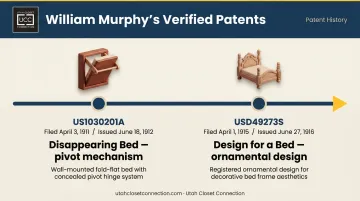
Claims about a 1900 patent application or a 1908 "In-A-Dor" patent don't have verified primary records to support them. The 1912 patent is the documented foundation.
The Murphy Wall Bed Co. appears as the patent assignee on US1030201A, confirming a company structure existed by 1911. The legal incorporation date for what became the Murphy Door Bed Company in New York wasn't established until 1925.
The Rise of the Murphy Bed: Growth and Peak (1900s–1920s)
From San Francisco to New York
As the Murphy bed's reputation grew, the company's center of gravity shifted east. A 1924 company yearbook lists a New York address at 469 Fifth Avenue — and the yearbook itself tells the marketing story clearly. Filled with apartment floor plans, building illustrations, and specifications, it was aimed at architects and developers, not individual consumers. The Murphy bed was being sold as an amenity to build into new apartment construction.
The formal New York incorporation — as the Murphy Door Bed Company — followed in 1925.
Why the Timing Was Perfect
Smithsonian curator Robyn J. Einhorn attributed the Murphy bed's rapid adoption to "a combination of good timing, a quality product, and an inventive marketing strategy." Three converging pressures made the timing ideal:
- Rapid urbanization pushed more people into dense city living
- Population growth created a housing shortage in major cities
- Apartments kept shrinking to fit more tenants per building
A bed that disappeared into the wall wasn't a novelty — it was a practical answer to a real constraint.
The Smithsonian also notes that through the 1920s, newspaper advertisements for apartments specifically used the Murphy bed as a selling point to attract tenants — the furniture equivalent of listing modern appliances or hardwood floors.
How "Murphy Bed" Became a Generic Household Term
Murphy's own marketing cycled through several names — "Disappearing Bed," "In-A-Dor Bed," "wall bed," "fold-away bed" — but none of them stuck the way his surname did.
The name "Murphy bed" followed the same trajectory as Escalator, Aspirin, and Thermos — brand names that entered everyday language so thoroughly that they stopped functioning as trademarks. In trademark law, this process is called genericide: when a brand name becomes the generic word for a product category, legal protection is lost.
The 1989 Ruling
The legal endpoint came in Murphy Door Bed Co., Inc. v. Interior Sleep Systems, Inc., 874 F.2d 95 (2d Cir. 1989). The U.S. Court of Appeals for the Second Circuit held that "Murphy bed" had been appropriated by the public to designate a type of bed — not a specific manufacturer's product — and therefore could not support a trademark infringement claim.
That ruling didn't emerge from nowhere. The Patent and Trademark Office had already refused trademark registration in 1981 and 1982, and the Trademark Trial and Appeal Board affirmed that position in 1984. The 1989 appellate decision was the definitive conclusion.
Today, any wall bed can legally be called a Murphy bed. The name survives through cultural habit, not legal protection.
How the Murphy Bed Has Evolved Over Time
From Basic Pivot to Modern Lift Systems
Murphy's 1912 patent describes a pivot mechanism that allowed the bed frame to swing relative to a wall opening. The original design relied on the frame's own geometry for support — not the spring counterbalance that often gets attributed to it in popular accounts.
Modern mechanisms are considerably more refined:
- Piston/gas lift systems: use compressed air to lower the bed smoothly and quietly, hold it closed without springs, and have fewer moving parts prone to failure
- Spring-driven lift systems: use adjustable spring force to counterbalance the mattress weight; more common in DIY kit form and generally lower in cost
Both systems represent a significant improvement over the original mechanism in terms of ease of use and long-term reliability.
Sizes and Orientations
The original Murphy bed accommodated a single (twin) mattress in a vertical orientation. The modern market covers considerably more ground:
- Sizes: Twin, full, queen, and king
- Vertical installation: Folds up on the long edge — requires standard ceiling height
- Horizontal installation: Folds up on the short edge — better for rooms with lower ceilings
Style Variants
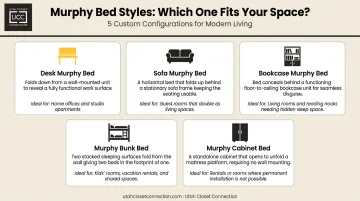
Five distinct configurations have developed over the decades:
| Variant | How It Works |
|---|---|
| Desk Murphy bed | A fold-down desk replaces the bed face when stored; some designs keep the desktop level as the bed lowers |
| Sofa Murphy bed | A sofa is integrated into the cabinet face; distinct from a pullout sofa bed |
| Bookcase Murphy bed | Hinged or bifold bookcase sections open to reveal the wall bed |
| Murphy bunk bed | Two sleeping platforms fold into a single wall panel — common in children's rooms |
| Murphy cabinet bed | A freestanding cabinet that opens into a bed without requiring wall attachment |
For Utah clients looking to maximize the space around any of these configurations, Utah Closet Connection designs and installs custom built-in cabinetry surrounds — including flanking storage towers, integrated drawer systems, and full cabinet enclosures. With over 40 years in business and a lifetime workmanship warranty, their team serves Salt Lake County and the surrounding region.
Murphy Beds in Popular Culture and Today
A Century of Slapstick
The Murphy bed became a comedy prop almost as soon as it became a commercial product. The earliest institutionally verified film appearance is in Shut Up! (Biograph, August 1902), documented by the American Film Institute, in which a man folds a Murphy bed into the wall with his wife still inside it.
By 1915, Keystone Studios was using the "Disappearing Bed" as a recurring premise (the AFI documents Fatty's Reckless Fling, March 4, 1915, under the alternate title Disappearing Bed Story). The most celebrated example remains Charlie Chaplin's One A.M. (1916), a nearly solo performance where Chaplin is repeatedly trapped in the folding-bed mechanism — described by the Chaplin archive as an early comic struggle between a person and a machine.
The Murphy bed has since appeared in video games (The Sims 4's Tiny Living Stuff pack, released January 2020) and remains a recognizable shorthand for cramped urban living in film and television.
Why They're Still Relevant
Smithsonian curator Robyn J. Einhorn put it plainly: Murphy beds "continue to fill a need in living spaces of today, whether it is for small city apartments or suburban homes of empty nesters turning a college student's old bedroom into an office/guest space."
The design has seen documented revivals in every generation of urban housing pressure. The Washington Post reported an urban comeback as early as 1999; the Star Tribune tied another resurgence to micro-condos in 2014. None of these moments required a new invention — just the same space problem Murphy solved in 1900.
The economic logic is consistent across all three eras:
- Rising housing costs reduce average square footage per resident
- Dual-use rooms (office by day, guest room by night) stretch the value of each square foot
- No structural changes required — a Murphy bed installs into existing walls without major renovation
Frequently Asked Questions
What are foldable beds called?
Foldable beds that store against a wall are most commonly called Murphy beds, wall beds, pull-down beds, or fold-down beds. "Murphy bed" is the most widely recognized generic term; "wall bed" is the more literal, descriptive term for the mechanism.
What is a Japanese folding bed called?
The traditional Japanese folding bed is a futon (a thin, foldable mattress placed on the floor and stored in a closet when not in use). The design differs from a Western Murphy bed, though both solve the same space problem.
What was the Murphy bed originally called?
William Murphy called his invention the "Disappearing Bed," the name reflected in his 1912 patent (US1030201A). An earlier product was marketed as the "In-A-Dor" bed. The name "Murphy bed" emerged from public usage and the company's branding over time.
When was the Murphy bed invented?
Murphy's key "Disappearing Bed" patent was filed April 3, 1911 and issued June 18, 1912. The Murphy Wall Bed Co. appears on that patent as assignee, confirming a commercial operation existed by that point — rooted in early 1900s San Francisco.
Is a Murphy bed the same as a wall bed?
The terms are used interchangeably. "Wall bed" describes the functional mechanism — any bed that folds against or into a wall. "Murphy bed" is the colloquial name derived from the inventor's surname. Both refer to the same type of furniture.
Did William Murphy ever trademark the name "Murphy bed"?
The Murphy Door Bed Company did not successfully secure or retain trademark protection for the name. The Patent and Trademark Office refused registration in 1981 and 1982, and in 1989 the U.S. Court of Appeals for the Second Circuit confirmed that "Murphy bed" had become a generic term no longer eligible for trademark protection.