Cabinet pricing itself swings just as widely. A stock cabinet box and a fully custom commercial unit can differ in cost by a factor of ten or more, depending on material, size, and how much customization you need. Many buyers overpay for features they don't need, or underbudget by ignoring installation and long-term maintenance.
This guide breaks down real pricing ranges, the biggest cost drivers, a full lifecycle cost breakdown, and how to compare low-cost versus high-cost options so you can set a budget that actually holds up.
Key Takeaways
- Cabinet pricing ranges from budget stock to premium custom builds, driven by materials and customization
- Size, finish level, hardware, and site accessibility all factor into your final quote
- Cheaper cabinets often cost more over time through repairs and early replacement
- Total cost of ownership includes installation, maintenance, and upgrades, not just sticker price
How Much Do Cabinets Cost? (Pricing Overview)
Cabinets don't come with one universal price tag. Cost depends on the cabinet type, the materials used, the size of the project, and whether you're buying from a big-box retailer or a custom cabinet maker.
Before you get a quote, watch for these common budgeting mistakes:
- Underestimating installation costs — labor can add $100 to $200 per linear foot on top of the cabinet price
- Choosing stock sizes that don't fit the space, leading to wasted filler panels or awkward gaps
- Forgetting maintenance or upgrade costs that show up years after installation
Typical Cost Ranges
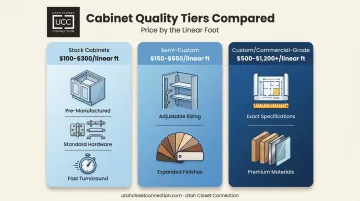
Here's what installed pricing typically looks like across the three main categories, based on current cabinet industry pricing guides:
| Cabinet Type | Price Per Linear Foot |
|---|---|
| Stock/basic cabinets | $100–$300 |
| Semi-custom cabinets | $150–$650 |
| Fully custom/commercial-grade | $500–$1,200+ |
These ranges usually include base materials, standard hardware, and standard installation. They typically exclude permits, demolition of old cabinets, premium hardware upgrades, and specialty features like pull-out organizers or soft-close mechanisms.
Each category fits a different type of project:
- Stock cabinets: Pre-manufactured with standard doors, hinges, and slides, built for speed. Best for budget-conscious buyers, rental properties, and tight-turnaround projects.
- Semi-custom cabinets: Adjustable sizing plus an expanded range of finishes and hardware, delivering a personalized look without full custom pricing.
- Custom and commercial-grade cabinets: Built to exact specifications with premium materials, spanning hand-finished residential kitchens to industrial storage rated for daily wear in a warehouse or workshop.
Businesses that need durable, industry-specific storage often work with specialists rather than general contractors. Utah Closet Connection, for example, designs custom commercial storage cabinets built around a business's actual workflow, and backs every installation with a lifetime workmanship warranty.
Key Factors That Affect the Cost of Cabinets
Pricing depends on more than overall size. Technical specs, materials, and intended use all shape the final number.
Material & Build Quality
Standard materials like MDF, particleboard, and laminate cost less upfront but can warp or chip under heavy or prolonged use. Premium options such as solid hardwood and marine-grade plywood cost more but hold up better in high-traffic residential kitchens and industrial environments.
Commercial buyers should also consider tested performance, not just material labels. Under ANSI/AWI 0641 standards, base cabinet load capacity ranges from 45 pounds per square foot at Duty Level 1 up to 115 pounds per square foot at Duty Level 4.
A commercial cabinet rated for the wrong duty level will fail faster than a residential-grade box, regardless of what wood it's made from.
Size, Scale & Number of Units
Total linear footage or unit count scales cost directly. A large commercial installation, however, often prices differently per unit than a single kitchen, since bulk orders can bring per-foot costs down even as the total project cost rises.
Level of Customization
Off-the-shelf prefab cabinets cost less than units built to exact space, weight-load, or industry specifications. Custom configurations, such as tool storage or heavy equipment cabinets, cost more upfront but eliminate wasted space, which is critical in tight commercial layouts.
Finishes, Hardware & Add-Ons
Small upgrades add up fast:
- Soft-close hinges
- Pull-out trays and drawer organizers
- Specialty racks or dividers
- Premium finish coatings
Each of these adds incrementally to the total, so it pays to prioritize which ones actually improve daily use.
Installation & Site Requirements
Site accessibility and existing infrastructure affect labor costs directly. Cabinets that are shop-built and delivered typically install faster than units built in-place, and tight commercial spaces or difficult-to-reach areas usually push labor costs higher.
Cost Breakdown of Cabinets: Beyond the Purchase Price
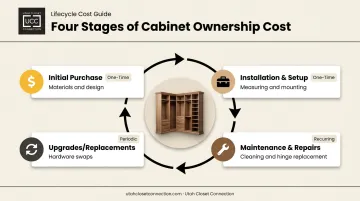
The sticker price is only one part of the total cost. Smart budgeting accounts for the full lifecycle of the cabinets, not just the initial invoice.
| Cost Category | Frequency | What It Covers |
|---|---|---|
| Initial purchase | One-time | Materials, design, and base unit cost before labor |
| Installation & setup | One-time | Measuring, assembling, delivering, and mounting on-site |
| Maintenance & repairs | Recurring | Cleaning, hardware tightening, occasional refinishing or hinge replacement |
| Upgrades / replacements | Periodic | Swapping hardware, adding organizers, replacing units as needs change |
Skipping any one of these categories in your initial budget almost always leads to surprise costs later. Maintenance is easy to overlook until a hinge fails or a drawer slide sticks.
Utah Closet Connection backs every installation with a lifetime workmanship warranty, helping offset that recurring maintenance cost category.
Low-Cost vs. High-Cost Cabinets — What's the Difference?
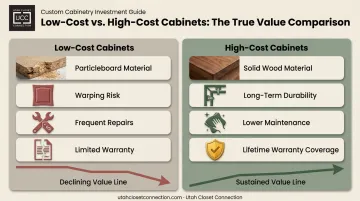
Budget and premium cabinets aren't just separated by price. They differ in durability, maintenance needs, and long-term value, as this comparison shows:
| Factor | Low-Cost Cabinets | High-Cost Cabinets |
|---|---|---|
| Materials | Particleboard or MDF | Solid wood or industrial-grade materials |
| Durability | Warps or chips under heavy use | Withstands years of daily wear |
| Maintenance | Repairs or replacement sooner | Lower long-term costs |
| Warranty | Limited coverage | Often lifetime workmanship coverage |
Durability & Build Quality
Material quality drives most of this gap. Lower-cost cabinets rely on particleboard or MDF, which can warp under heavy use, while higher-cost cabinets use solid wood or industrial-grade materials built to last in commercial or high-traffic settings.
Maintenance & Long-Term Value
Budget cabinets often need repairs or full replacement sooner than expected, adding hidden costs later. Well-built, higher-cost cabinets reduce these long-term expenses and typically carry stronger warranties.
Utah Closet Connection, for example, backs every installation with a lifetime workmanship warranty — a sign the cabinetry is built to outlast the first few years.
How to Budget Smart for Your Cabinet Project
The right budget balances upfront cost with actual usage needs. It's not about chasing the lowest quote.
Before you request estimates, weigh these factors:
- Intended use and workload: light home storage versus heavy commercial or industrial use
- Frequency of use: daily heavy traffic requires tougher hardware and materials
- Durability or compliance standards: required for your industry
- Available installation infrastructure: site access and existing wiring or plumbing
Common budgeting mistakes to avoid:
- Focusing only on the upfront price and ignoring lifecycle costs
- Skipping maintenance-cost planning entirely
- Over-specifying features you'll rarely use
- Choosing the cheapest bid without vetting the contractor's reliability
Getting multiple, itemized estimates helps you compare pricing apples-to-apples. Utah Closet Connection offers free design consultations and typically delivers estimates within one to two weeks. That fast turnaround gives businesses a clear number to plan around before committing to a project.
Frequently Asked Questions
How much does it cost to build custom cabinets?
Custom cabinets typically run $15,000 to $25,000 for a mid-size project, with a national average around $18,600 for roughly 30 linear feet of maple cabinetry. Costs vary based on wood species, finish, and design complexity.
What is the average cost per linear foot for commercial cabinets?
Commercial-grade cabinets often cost $270 to $500 per linear foot, driven up by heavier-duty materials and stricter load specifications. Always confirm whether the quote includes installation.
Is it cheaper to buy stock cabinets or have them custom-built?
Stock cabinets are cheaper upfront but limited in fit and durability, especially in awkward or non-standard spaces. Custom cabinets cost more initially but eliminate wasted space and typically last longer.
What factors increase the cost of commercial storage cabinets the most?
Material grade, customization level, and installation complexity are the biggest cost drivers. Heavier load requirements and tight site access can also push labor costs higher.
How long does it take to get a quote for custom cabinets?
Turnaround varies by provider, but many custom cabinet companies deliver estimates within one to two weeks of an initial consultation. Utah Closet Connection follows this same timeline for both residential and commercial projects.
Do commercial cabinets cost more than residential kitchen cabinets?
Commercial cabinets are often priced higher per unit because they're built for durability and heavier daily use. That said, large-scale installations can sometimes offer better per-linear-foot value than smaller residential jobs.