
Here's what most homeowners miss, though. They budget for the bed itself and forget that installation is a separate line item entirely. Get the installation cost wrong, and your "simple space-saving project" turns into a surprise invoice.
Installation pricing swings widely based on bed size, wall structure, materials, and whether you DIY or hire a licensed pro. This guide breaks down real 2026 pricing ranges, what pushes costs up or down, and how to budget so you're not caught off guard.
Key Takeaways
- Installation typically runs $300 to $4,000+, separate from the bed unit itself.
- Wall type, bed size, and customization level are the three biggest cost drivers.
- DIY saves labor costs upfront but carries real safety risk if anchoring is done wrong.
- Custom, built-in cabinetry installations can push total project costs to $15,000 or more.
How Much Does It Cost to Install a Murphy Bed in 2026? (Pricing Overview)
There's no single sticker price for Murphy bed installation. Cost depends on the bed's size, your wall's condition, labor rates, and how much finish work you want.
Three budgeting mistakes trip up most homeowners:
- Assuming the bed price and installation price are the same thing, when in reality they almost never are
- Underestimating room-prep work, like baseboard removal or outlet relocation
- Forgetting that hardwood, masonry, or metal-stud walls cost more to anchor into than standard drywall-over-stud construction
Typical Cost Range for 2026
| Installation Tier | Typical Cost Range | What's Usually Included |
|---|---|---|
| Basic/DIY-assisted | $100–$800 | Hardware, basic assembly, minimal trim work |
| Standard professional | $2,000–$4,000 (average around $3,000) | Full stud anchoring, mechanism calibration, safety checks |
| Custom/built-in | $3,500–$15,000+ | Cabinetry, shelving, premium finishes, design services |
According to Angi's 2026 cost data, a standard professionally installed project averages $3,000. Fixr reports custom installations can run $3,000 to $15,000 once cabinetry and design work enter the picture.
These figures generally include labor, basic hardware, and anchoring. They typically exclude the bed unit's purchase price, electrical work, and custom trim beyond standard adjustments.
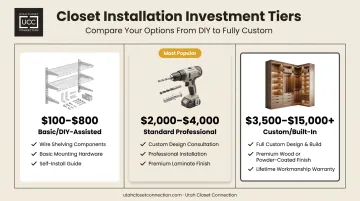
Basic/DIY Installation
This covers a simple wall-mounted frame with minimal trim work — think prefab kits from a big-box retailer. Best for: renters, apartment dwellers, and budget-conscious first-time buyers who are comfortable with basic tools.
Standard Professional Installation
This tier includes full anchoring into wall studs, mechanism calibration, and baseboard adjustment as needed. Best for: most homeowners who want safety assurance and warranty coverage without going fully custom.
Custom/Built-In Installation
Here you're paying for cabinetry, shelving, desk add-ons, and premium hardwood or laminate finishes. Best for: home offices, guest suites, or design-focused remodels where the wall bed needs to look built-in, not bolted on.
This is the tier where a cabinetry specialist like Utah Closet Connection adds the most value, matching finishes, hardware, and storage details to the rest of the room instead of dropping in a generic unit.
Key Factors That Affect Murphy Bed Installation Cost
Installation pricing depends on structural, material, and customization factors, not just the size of the mattress you're hiding.
Bed Size and Configuration
Twin and full beds cost less to install than queen-size or vertical builds. Larger beds weigh more, require more anchoring points, and demand precise mechanism alignment. Angi's data shows installed ranges climbing from $1,500–$2,200 for twin models up to $1,500–$4,000 for queen.
Wall Type and Structural Requirements
Drywall-only walls require locating studs (or adding blocking) before anchoring. Masonry or metal-stud walls raise both labor time and hardware costs, since standard screws and hollow-wall anchors aren't strong enough to hold a wall bed safely.
Material and Mechanism Quality
MDF and particleboard frames cost less than solid hardwood, but they also carry less long-term durability. Lift mechanisms vary too:
- Spring-based systems: generally simpler and less expensive
- Piston-lift systems: smoother operation, often at a higher hardware cost
- Motorized systems: push-button operation, typically the highest upfront hardware cost

Level of Customization
Add-ons like side shelving, desks, or bookcase-front panels increase both material and labor costs. Angi lists shelving additions in the $200–$1,000 range and full cabinetry upgrades between $500–$2,500.
Room Prep and Finishing Work
Baseboard removal, outlet relocation, trim work, and touch-up painting rarely show up in an initial quote, but they add up. Manufacturer guides consistently call out baseboard notching as a required step before wall anchoring can begin.
Cost Breakdown: DIY vs. Professional Murphy Bed Installation
Total installation cost goes beyond labor alone. DIY brings tool costs, time investment, and risk. Professional installation brings guaranteed workmanship, at a higher price point.
DIY Installation
Expect to spend on tool rental or purchase and replacement hardware, plus a solid chunk of your weekend. Most product manuals note installations take 2 to 4 hours for simpler models, though heavier units can take 8 to 12 hours and require two people.
DIY works fine if you're precise with stud-finding and mechanism alignment. Get it wrong, though, and you're looking at a bed that doesn't fold smoothly — or worse, one that isn't securely anchored.
Professional Installation
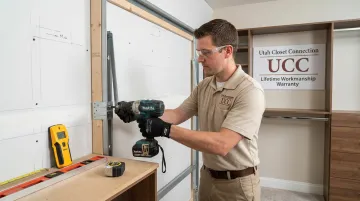
Professional labor typically runs $50–$150 per hour or a flat $300–$800, according to Angi's benchmarks. That fee generally covers stud or masonry anchoring, mechanism calibration, and a final safety check.
Companies like Utah Closet Connection use licensed contractors for every installation, backed by a lifetime workmanship warranty. That warranty is tied specifically to professional installation, so it reduces your long-term risk of improper anchoring or mechanism failure in a way a DIY attempt simply can't match.
| Comparison | DIY | Professional |
|---|---|---|
| Safety | Higher risk of misaligned mechanisms or improper anchoring | Consistent calibration, code-compliant anchoring |
| Long-term value | Potential repair or re-installation costs if done incorrectly | Warranty coverage, safer long-term operation |
The safety piece matters more than most people realize. In late 2024, the CPSC issued a recall for certain wall beds capable of detaching and falling, creating serious impact and crush hazards. Proper anchoring is the primary reason professionals get hired for this job.
How to Budget for Your Murphy Bed Installation (and Avoid Common Mistakes)
Before setting a budget, evaluate the total project scope — not just the bed's price tag.
Consider these factors:
- Room type and wall structure (drywall vs. masonry vs. metal stud)
- Desired finish and customization level (basic frame vs. built-in cabinetry)
- Existing baseboard or trim modifications (needed for a clean fit)
- Long-term maintenance needs (including mechanism servicing down the road)
With those factors mapped out, steer clear of these common budgeting mistakes:
- Focusing only on the bed's sticker price and ignoring installation entirely
- Skipping a wall assessment before ordering a specific model
- Over-customizing beyond what the room actually needs
Since pricing varies so much by project, a free in-home or virtual design consultation gets you a scope-specific quote rather than a generic online range. Utah Closet Connection offers exactly that, with estimates typically delivered within one to two weeks of your consultation.
Conclusion
Murphy bed installation costs in 2026 vary a lot depending on bed size, wall type, material choice, and whether you go DIY or professional. A basic setup might run $200 to $800 for hardware and simple installation. A custom built-in with cabinetry and premium finishes can climb past $15,000.
Understanding these cost components before you order a bed leads to fewer surprises and a more accurate budget. If you're in Salt Lake County, Utah County, or the surrounding areas and want a properly anchored, warranty-backed installation, reach out to Utah Closet Connection for a free design consultation and a quick, project-specific estimate.
Frequently Asked Questions
How much does it cost to install a Murphy bed?
Standard professional installation typically runs $2,000–$4,000, while custom or built-in projects with cabinetry can reach $15,000+. This is separate from the cost of the bed unit itself.
Are Murphy beds difficult to install?
Installation is doable but technical, requiring accurate stud-finding and precise anchoring before the folding mechanism can be calibrated correctly. That's enough complexity that many homeowners choose professional help instead of tackling it alone.
Do all Murphy beds require drilling into the floor?
Most Murphy beds anchor to wall studs rather than the floor. Some heavier units or built-in cabinetry configurations may include additional floor-level support, depending on the manufacturer's specifications.
How long does it take to install a Murphy bed?
Professional installation typically takes 1 to 2 hours per bed and is generally faster and more consistent. DIY installation ranges from 2 to 4 hours for lighter models up to 8–12 hours for heavier units requiring two people.
Is it cheaper to install a Murphy bed myself?
DIY saves on labor costs upfront, but it requires tools, time, and carries a higher risk of improper anchoring — which can lead to costly repairs later.
Do Murphy beds need to be anchored into wall studs?
Yes. Proper stud (or masonry) anchoring is essential for safety, particularly for larger queen-size beds where weight and leverage increase the risk of detachment if installed incorrectly.