

Introduction
Floor space is one of the most contested resources in a modern home. Whether you're in a Salt Lake City studio apartment, converting a spare bedroom into a home office, or trying to make a basement suite work for guests, the challenge is the same: one room needs to do two jobs.
Murphy beds have been solving that problem for over a century. According to a 2025 NAR report, 40% of surveyed buyers would now accept a smaller home — nearly double the 21% who said the same in 2022. That shift has renewed serious interest in furniture that earns its square footage around the clock.
This guide covers what a Murphy bed actually is, where the name came from, how the mechanism works, what types exist, and what to check before buying one.
Key Takeaways
- A Murphy bed folds vertically against a wall when not in use, freeing the room for other uses
- Named after inventor William Lawrence Murphy, who patented the design in 1912
- Two main lift systems exist: spring-balanced and gas-piston, each with different trade-offs
- Four common configurations suit different rooms and budgets
- Wall anchoring into structural studs is non-negotiable for safety
What Is a Murphy Bed?
A Murphy bed is a bed hinged at one end that folds up — vertically or horizontally — to store flush against a wall or inside a cabinet when not in use. Pull it down, and it functions exactly like a standard bed. Fold it up, and the floor space returns.
You'll encounter several names for the same concept:
- Wall bed
- Pull-down bed
- Fold-down bed
- Hidden bed
- Stow-away bed
All five terms describe the same mechanism. "Murphy bed" spread so far into everyday language that a 1989 U.S. Court of Appeals ruling declared it a generic term — no single company could claim trademark ownership over it.
Physical Footprint
The numbers that matter most for planning:
| Measurement | Queen Benchmark |
|---|---|
| Closed depth (from wall) | ~16 inches |
| Open projection (floor space needed) | ~84–90 inches |
| Cabinet height | ~86–87 inches |
These are planning benchmarks based on manufacturer documentation. Actual dimensions vary by model — verify dimensions with your specific unit before purchasing.
Common Use Cases
Murphy beds make the most sense in:
- Studio apartments where the bedroom is the living room
- Guest rooms that double as home offices
- Basement suites used infrequently for sleeping
- Short-term rental units needing flexible configurations
- Spare bedrooms being converted to multi-use spaces
Most modern Murphy beds integrate desks, shelving, sofas, or built-in cabinetry — turning what used to be just a sleeping surface into a complete room system designed around how the space actually gets used.
Why Is It Called a Murphy Bed? History and Origin
The name comes directly from William Lawrence Murphy (1856–1957), a San Francisco inventor who applied for patents on fold-up bed designs in the early 1900s.
The Origin Story
According to the Smithsonian's account, Murphy lived in a one-room apartment and was courting a young opera singer. Social customs of the era prevented a woman from entering a man's bedroom — so Murphy designed a bed that folded away, converting his room into a parlor. The couple eventually married in 1900.
The Patent Record
| Patent | Filed | Issued | Description |
|---|---|---|---|
| US1030201A | April 3, 1911 | June 18, 1912 | "Disappearing Bed" — utility patent |
| USD49273S | April 1, 1915 | June 27, 1916 | "Design for a Bed" — design patent |
Those patents protected the mechanism — but Murphy never trademarked the name "Murphy bed" itself. By 1989, the Second Circuit Court ruled in Murphy Door Bed Co. v. Interior Sleep Systems, Inc. that the public had adopted the term as a generic product description, putting it permanently into common usage.
Cultural Peaks and Revivals
Fold-up beds predated Murphy, but his counterbalanced pivot system made them genuinely practical. Apartment advertisements promoted Murphy beds throughout the 1920s. The concept saw a revival in 2014 as urban micro-condos multiplied, and again in 2022 as spare bedrooms became home offices. The New York Times covered both trends directly.
How Does a Murphy Bed Work?
Murphy beds work on counterbalancing — a mechanical system that offsets the weight of the mattress and platform so one person can raise or lower it with minimal effort.
The Two Lift Systems
Spring-balanced systems use individual coil springs whose count adjusts based on bed size and mattress weight. Common in traditional and mid-range designs.
Gas-piston systems use pneumatic pressure to counterbalance the platform. Found in most modern designs — the motion is smoother and more controlled, especially when lowering the bed.
Spring systems can be adjusted over time as mattress weight changes. Gas pistons require less routine maintenance but are harder to recalibrate if you switch to a significantly heavier mattress.

Hinge, Platform, and Retention
The bed frame anchors to a wall-mounted cabinet. When lifted, the sleeping platform sits flush inside the cabinet. When pulled down, it locks into position.
No box spring is used — the mattress rests on a wooden platform or slat system. To keep the mattress in place when vertical, manufacturers use elastic retention straps, buckle straps, or panel guards — the choice depends on the model.
Wall-Mounted vs. Floor-Mounted
Modern Murphy beds are almost exclusively wall-mounted. The installation method affects both safety and how easily the unit can be repositioned if you move.
- Wall-mounted: Anchors into structural wall studs — the standard for most residential installs
- Floor-mounted: Bolts to the floor instead; less common and more invasive to install or relocate
Types of Murphy Beds
Orientation: Vertical vs. Horizontal
Vertical (portrait) models fold up toward the ceiling. They're the standard choice for rooms with normal ceiling heights and work well with queen and full mattresses.
Horizontal (landscape) models fold sideways along the wall. Better suited for rooms with lower ceilings or limited vertical wall space — common in basement installations.
Style Configurations
| Type | Best For | Key Trade-Off |
|---|---|---|
| Standard cabinet | Guest rooms, studios | Lowest complexity; occupies dedicated wall |
| Desk-integrated | Home office/guest room | Preserves work function; adds depth and cost |
| Sofa-integrated | Living/guest room | Adds daytime seating; increases footprint |
| Murphy bunk bed | Kids' rooms, multi-guest spaces | Sleeps two; requires more vertical clearance |
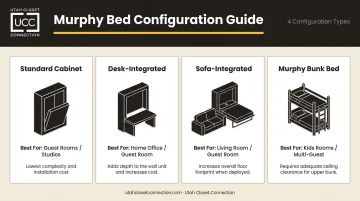
Desk-integrated models are worth particular attention for homeowners converting a spare bedroom into a home office. The desk typically folds away automatically as the bed opens — no dismantling required.
Ready-Made vs. Custom
Ready-made units come in standard sizes and finishes at a lower entry price, but they rarely fit a room perfectly. Custom-built Murphy beds are designed around your exact dimensions, materials, and surrounding cabinetry.
Custom tends to be the stronger choice when you want:
- A seamless look that integrates with existing built-ins or storage walls
- Non-standard room dimensions that off-the-shelf sizes don't accommodate
- Specific finishes, hardware, or configurations not available in standard lines
The Pros and Cons of a Murphy Bed
Benefits
- Reclaims significant floor space when stored — roughly 33 square feet for a queen, based on standard dimensional math
- Enables one room to serve two functions without storing a separate mattress
- Compatible with most standard mattress types (no box spring required)
- Modern mechanisms are smooth and safe when properly installed
- Aesthetically comparable to built-in cabinetry when surrounded by custom storage
Drawbacks
- Requires adequate wall space and ceiling height — verify before purchasing
- Costs more than a conventional bed frame, with integrated or custom builds running highest
- Bed must be made before folding up each time
- Installation requires precision; mounting into structural studs is essential
Understanding Real Safety Risks
This deserves direct attention. The CPSC has issued recalls covering more than 206,000 wall beds, including one fatality linked to wall detachment. Improperly mounted units can fall.
Before purchasing, check the CPSC recall database for your specific model. Insist on installation into verified structural studs — not just drywall. If you're unsure whether your wall can support the load, a licensed contractor can confirm stud placement before installation begins.
What to Consider Before Getting a Murphy Bed
Room Measurements First
Measure before you shop:
- Ceiling height: Most vertical queen cabinets stand 86–87 inches; confirm the model's cabinet height matches your room
- Wall width: The cabinet needs clear, unobstructed wall space — typically 64–66 inches wide for a queen
- Open projection: You need 84–90 inches of clear floor depth when the bed is fully lowered
Mattress Compatibility
Murphy beds don't use box springs. Key limits to check:
- Thickness: Generally 8–12 inches, though some models accept up to 13 inches
- Weight: Queen systems typically specify 50–110 lbs depending on the mechanism
- Construction: Memory foam and pocketed-coil mattresses work well because they stay supported when vertical
Match these specifications to the exact model — not a general guideline. Manufacturer specs vary enough that one brand's limits won't apply to another.
Getting a Custom Integrated Solution
A standalone Murphy bed solves the sleeping problem. A fully integrated system — bed, cabinetry, shelving, and desk space built into a single wall unit — solves the room problem.
For Salt Lake City area homeowners pursuing that kind of result, Utah Closet Connection designs and installs custom Murphy bed systems with flanking cabinetry, drawers, shelving, and home office components. Their licensed contractors bring over 50 years of combined experience to these projects, and all installations carry a lifetime workmanship warranty. Free design consultations are available, with estimates typically ready within one to two weeks, serving Salt Lake, Utah, Davis, Summit, and Weber counties.

Frequently Asked Questions
What is the purpose of a Murphy bed?
The primary purpose is to reclaim floor space by storing the bed vertically when it's not in use. This lets a single room function as both a bedroom and a living, working, or recreational space without requiring two separate rooms.
What's the difference between a wall bed and a Murphy bed?
The terms are largely interchangeable. Technically, "Murphy bed" refers to the original counterbalanced design patented by William Murphy, while "wall bed" is the broader modern term covering all fold-up bed designs, including piston-lift cabinet models.
Why is it called a Murphy bed?
It's named after inventor William Lawrence Murphy, who designed and patented the first counterbalanced fold-up bed in the early 1900s in San Francisco. The name entered common usage so thoroughly that courts ruled it couldn't be trademarked.
Are Murphy beds comfortable to sleep on?
A properly constructed Murphy bed with a suitable mattress — memory foam or pocketed coil, 8–10 inches thick — sleeps as comfortably as a standard bed. The fold-up mechanism has no effect on sleep quality.
Do Murphy beds have to be attached to the wall?
All high-quality Murphy beds require secure wall mounting into structural studs. Without it, both vertical and horizontal units risk tipping or collapsing — a documented safety concern that has prompted multiple CPSC product recalls.
What sizes do Murphy beds come in?
Murphy beds are available in twin, twin XL, full, queen, and king sizes. Twin, full, and queen are the most common. King options exist but require substantial wall width, making them less practical in most rooms.