

The honest answer is yes, Murphy beds can be just as comfortable as a traditional bed. The catch is that comfort doesn't come automatically. It depends on three specific factors: the mattress you choose, the quality of the frame and platform, and how the system is installed. Get those right, and you're sleeping on what amounts to a standard bed. Get them wrong, and the jokes about Murphy beds start to make more sense.
This article breaks down each factor clearly, so you know exactly what to look for.
Key Takeaways
- A Murphy bed can match traditional bed comfort — but only with the right mattress and a well-built frame
- Most standard mattresses are not designed for vertical storage and can deform over time
- Published mattress thickness limits vary by frame model (commonly 10–12 inches) — always check your specific unit
- Murphy beds consistently outperform sleeper sofas on sleep quality, though they require a larger upfront investment
- Strapping bedding and staying within the recommended mattress thickness prevents common comfort problems
The Real Answer: Are Murphy Beds Comfortable?
Yes — but with an important qualification.
A Murphy bed uses standard mattress sizes: twin, full, queen, and king. The sleeping dimensions are identical to a conventional bed, so there's no inherent size disadvantage. What separates a comfortable Murphy bed from an uncomfortable one comes down to three factors:
- Whether the mattress is designed for vertical storage
- Whether it fits within the frame's thickness limits
- Whether the platform beneath it is rigid enough to provide real support
Real-world evidence backs this up. A Western Living editor reported five months of nightly use on a wall bed, describing it as just as comfortable and supportive as her previous conventional bed. Architectural Digest notes that Murphy beds can be as comfortable as a traditional frame when the platform and mattress are solid.
These are qualitative assessments, not lab studies — but they reflect what the evidence supports. Get the components right, and a Murphy bed sleeps as well as any conventional frame.
The Mattress Is the Foundation of Murphy Bed Comfort
Most Murphy bed comfort problems trace back to one source: the wrong mattress. Not all mattresses handle vertical storage, and choosing an incompatible one leads to degraded support within months.
Why Standard Mattresses Cause Problems
When a Murphy bed is stored, the mattress stands upright for hours at a time — sometimes all day. Most consumer mattresses are not built for this. Tempur-Pedic, for example, explicitly instructs owners to store its mattresses flat, not on their side. The Sleep Foundation echoes this with general guidance to keep stored mattresses horizontal.
Loose internal materials — highly pliable latex, gel layers, individually pocketed coils — can shift or slump toward the bottom during vertical storage. Over time, this creates uneven support and can permanently alter the sleep surface.
What a Compatible Mattress Looks Like
Murphy-bed-compatible mattresses are engineered differently. According to Wilding Wallbeds, suitable construction includes:
- Layers bonded or stitched together so they stay in place during vertical storage
- Dense foam cores rather than loose-fill or highly pliable latex
- Connected coil systems (Bonnell or continuous) rather than individually pocketed coils, which can migrate over time
Named compatible products include Serta's SleepTrue and iComfort lines specifically configured for wall-bed use, as well as Boyd mattresses designed for Murphy frames.
Thickness: Check Your Specific Frame
Published thickness limits vary by frame model:
| Frame/Model | Maximum Mattress Thickness |
|---|---|
| Murphy Bed Depot range | 10 inches |
| Wilding S-100 | 12 inches |
| Breda Urban | Up to 13 inches (recommended: under 11 inches) |

There is no universal 6–12 inch rule. The number that matters is the one in your specific frame's manual. Exceeding it can prevent the bed from closing or strain the lift mechanism — both comfort and safety issues.
Memory foam stores well vertically, which makes it a common pick for Murphy beds. Just check the density rating before buying — low-density foam bottoms out under regular use and won't provide lasting support regardless of how well it holds its shape during storage.
Why the Bed Frame and Platform Quality Matter
Even the right mattress will feel poor on a weak platform. A frame that flexes or sags under weight transfers that deflection directly to the sleeper's spine and hips — it doesn't matter how good the mattress is.
What to Look for in Frame Construction
Quality Murphy bed frames disclose their full support design. Look for:
- Real wood or furniture-grade plywood in the cabinet structure (Wilding uses a combination of solid wood and furniture-grade plywood)
- A flat, rigid mattress deck — the panel or slatted base must not flex when weight is applied
- A lift mechanism rated for the combined weight of the mattress and sleepers
Slatted systems like Clei's patented CF09 bed base are a legitimate alternative to solid panel decks, provided they're designed for the load. The key is that the manufacturer discloses and specifies the support system clearly.
Anchoring Is Not Optional
A Murphy bed must be properly anchored to structural wall members — not just drywall. This is where installation quality becomes a direct comfort and safety issue.
The CPSC recalled approximately 8,200 Cyme Tech Murphy beds after 146 reports of beds falling or breaking and 62 injuries, including fractures and concussions. A separate 2025 recall involved beds that fell during assembly because they weren't anchored. A unit that shifts or creaks under weight is a structural problem, not just a comfort one.
For homeowners in Salt Lake County and surrounding areas, Utah Closet Connection builds the custom cabinetry and wall unit surrounds that house Murphy bed systems. Having a licensed contractor handle the surrounding structure and anchoring process ensures the structural foundation that comfort depends on — and their installations carry a lifetime workmanship warranty.
Murphy Bed vs. Sleeper Sofa: Which Is More Comfortable?
The comfort gap between these two options comes down to one thing: mattress support.
A sleeper sofa uses a thin fold-out mattress laid over a metal bar frame. Current sleeper sofa mattress thicknesses from major manufacturers span roughly 4 to 5.5 inches — the La-Z-Boy Leah Queen uses a 5.5-inch innerspring mattress, while the Room & Board Berin sits at 4 inches. Wirecutter's sleeper sofa testing consistently identifies crossbar pressure through thin mattresses and sagging as recurring complaints.
A Murphy bed, by contrast, uses a full-depth compatible mattress on a flat, rigid platform. The Wilding S-100 accommodates up to 12 inches of mattress depth. At that depth, you're working with the same range as a standard bed — memory foam, hybrid, or innerspring included.
| Feature | Murphy Bed | Sleeper Sofa |
|---|---|---|
| Mattress depth | Up to 10–12+ inches | Typically 4–5.5 inches |
| Support platform | Flat, rigid panel or slats | Folding metal bar frame |
| Common comfort complaints | None when properly set up | Crossbar pressure, sagging |
| Installation required | Yes — wall mounting | No |
| Daytime function | Floor space reclaimed | Doubles as seating |
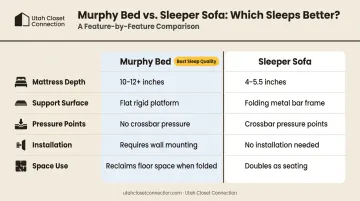
A sleeper sofa requires no installation and doubles as seating year-round — that's a genuine convenience. A Murphy bed requires professional wall mounting, but delivers significantly better sleep quality and reclaims usable floor space during the day.
Tips to Maximize Murphy Bed Comfort Night After Night
Choosing the right mattress and frame is the foundation — but daily habits are what protect that investment long-term:
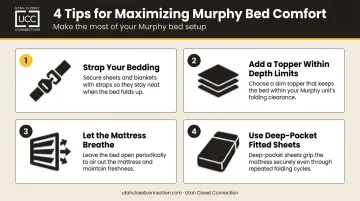
- Strap your bedding before closing the bed. Retention hardware — velcro straps, buckle straps, or tension bands — is available on many systems. Skipping this step leads to bunched fabric under the sleeper each night.
- Add a topper within your frame's total depth allowance. If the mattress firmness doesn't suit the primary sleeper, a thin topper can adjust feel. Add one only if it keeps the total mattress depth within the frame's published limit.
- Let the mattress breathe before sleeping. Opening the bed a few minutes before use allows airflow to normalize temperature and freshness — especially relevant when the mattress is stored in an enclosed cabinet.
- Use fitted sheets with deep pockets. These stay put better during vertical storage and reduce the chance of the sleep surface shifting during the night.
Frequently Asked Questions
What is more comfortable, a Murphy bed or sleeper sofa?
Murphy beds are more comfortable. They use a full-depth mattress on a rigid platform, while sleeper sofas rely on thin mattresses (typically 4–5 inches) over a folding metal frame that creates crossbar pressure points — compared to 10+ inches of depth on most Murphy-compatible mattresses.
Can I use a regular mattress in a Murphy bed?
Most regular mattresses are not designed for vertical storage. Internal components like pocketed coils and loose latex layers can shift or slump over time, deforming the sleep surface. Murphy-bed-compatible mattresses are specifically engineered to handle upright storage without internal movement.
How thick should a Murphy bed mattress be?
Thickness limits vary by frame model — Murphy Bed Depot caps at 10 inches, while Wilding's S-100 allows up to 12 inches. Always check the specific frame's manual. Exceeding the limit can prevent the bed from closing or damage the lift mechanism.
Do Murphy beds feel sturdy when you sleep on them?
A properly built and correctly installed Murphy bed with a rigid platform feels as sturdy as a traditional bed frame. The key variables are the quality of the frame materials and whether the unit is securely anchored to structural wall members — not just drywall.
Is a Murphy bed comfortable for two people?
Yes. A queen or king Murphy bed offers the same sleeping dimensions as a standard bed of that size. Just make sure the mattress and frame are both rated for the combined load.
How do you keep sheets from falling off a Murphy bed?
Most Murphy beds include velcro straps or buckle straps to hold bedding in place when the bed is folded up. Using fitted sheets with deep pockets adds another layer of security.