
Introduction
Most Utah mudrooms start with good intentions. By February, they're buried under snow-caked ski boots, muddy trail runners, and a backpack avalanche no one claims responsibility for.
The problem isn't a lack of effort. It's that most mudrooms are set up with the wrong system for the people actually using them. Add kids, multiple adults, and Utah winters that demand a full rotation of heavy boots, and the standard shoe rack simply can't keep up.
This guide covers practical shoe storage solutions for every budget — from simple drop zones to fully custom built-ins — plus design tips to keep the space functional year-round. Whether you have a dedicated mudroom or a cramped entry closet, matching the storage system to how your household actually operates makes all the difference.
Key Takeaways
- Audit your space and shoe count before buying anything
- Built-in cubbies and storage benches solve the two biggest mudroom problems in one footprint
- Vertical storage multiplies capacity without expanding your footprint
- Utah winters require dedicated tall-boot zones with enough height for knee-high boots
- A mix of open and closed storage keeps things accessible and visually clean
Assess Your Mudroom Before Choosing a Storage Solution
Before purchasing a single shelf or cubby, spend ten minutes on an honest audit. Most mudroom systems fail because they're sized for an imaginary household, not the real one.
Start with three measurements:
- Available floor area (length × width, noting any doors that swing into the space)
- Wall height from floor to ceiling
- Under-bench or under-seat depth if you plan to use that zone
Then count shoes — not the total collection, but how many pairs need to be accessible at any one time. That number is usually smaller than it feels. Two to three pairs per person covers daily life for most families; the rest is seasonal overflow that belongs elsewhere.
Ask These Questions Before You Buy
- What shoe types dominate your household? Knee-high boots need very different clearance than sneakers or sandals.
- Does everyone need a dedicated zone, or will a shared system work? (Households with kids almost always do better with individual zones.)
- What else competes for this space — backpacks, coats, sports equipment, wet umbrellas?
The system that sticks is the one built around how your family actually moves through the space — not how you'd like them to.
Top Mudroom Shoe Storage Ideas
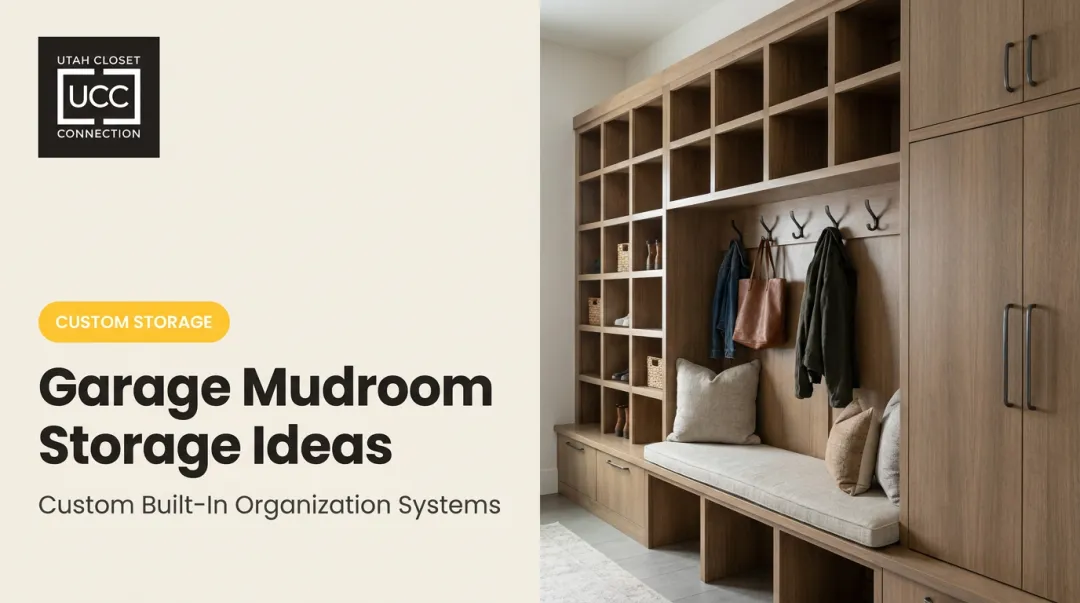
Built-In Shoe Cubbies
Built-in cubbies are consistently the most organized option for one simple reason: every pair has a fixed home. When there's no decision to make about where a shoe goes, it goes there. That removes the low-grade friction that leads to piling.
Wayfair's shoe storage guide gives a practical benchmark for cubby sizing: approximately 12 inches wide, 8 inches deep, and 5 inches high for standard shoes, with around 24 inches of height clearance for tall boots. These are retailer guidelines, not fixed standards — your household's actual footwear should drive the final dimensions.
Cubby systems range from a repurposed low bookcase to fully custom cabinetry with doors. For households with kids, assigning one cubby per family member creates personal accountability without demanding perfect neatness — each person owns their section, and tidying becomes self-contained.
Storage Benches with Compartments
The storage bench is the workhorse of mudroom design. It solves two problems at once: seating for putting shoes on and off, and storage beneath for the shoes themselves — via drawers, cubbies, or a lift-top compartment.
Two reference points worth keeping in mind when planning:
- Entry-level sizing: IKEA's TJUSIG bench (42.5" wide, ~8-pair capacity) is listed at $69.99 as of July 2026 — a reasonable baseline for entry-level options
- Ergonomic height: The U.S. Access Board's ADA standard specifies accessible bench seat height at 17–19 inches above the floor, a useful guide regardless of accessibility requirements
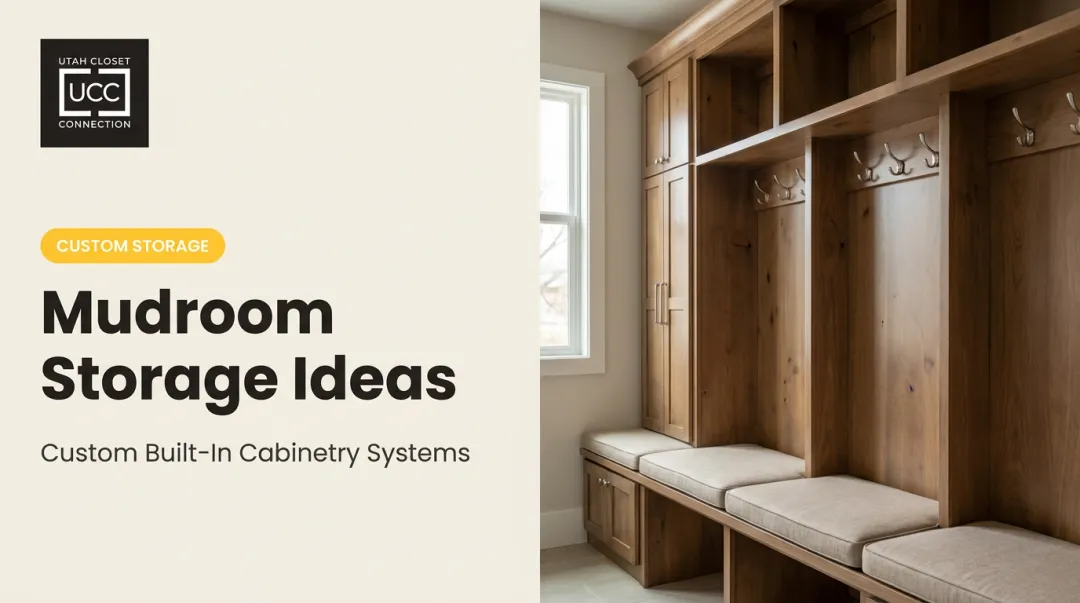
Built-in bench seating with custom storage beneath delivers a furniture-quality look that maximizes every inch, particularly in mudrooms where off-the-shelf dimensions never quite fit the wall.
Wall-Mounted Shoe Racks and Floating Shelves
Wall-mounted storage frees up floor space entirely, making it the right call for narrow mudrooms and tight entryways. A slim-profile rack holds multiple pairs without jutting into the walkway.
Two formats cover most needs:
- Tiered shoe racks — store pairs angled or flat, work well for sneakers and low shoes
- Floating shelves — spaced to accommodate both short shoes and tall boots, more flexible as needs change
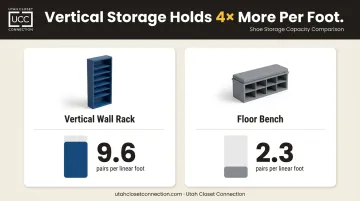
To illustrate the capacity difference, a ClosetMaid vertical organizer (22.5 inches wide, 57.5 inches tall) holds 18 pairs — roughly 9.6 pairs per linear foot of wall width. Compare that to a standard floor bench at around 2.3 pairs per linear foot, and the vertical advantage is clear.
Baskets, Bins, and Drop Zones
For households that won't maintain a precise system, a well-placed basket or durable bin is far better than no system at all. The drop zone philosophy accepts human behavior and contains the clutter rather than fighting it.
- Woven wicker baskets add warmth and texture while keeping shoes in one spot
- Wire or plastic bins handle muddy shoes better — easy to rinse or wipe down
- Assigning one basket per person scales this approach for families without demanding precision
Over-the-Door and Concealed Storage Options
Over-the-door organizers are underused in most mudrooms. They hang on the back of the mudroom door, store sneakers, kids' shoes, and sandals, and use vertical space that would otherwise go to waste — no floor footprint, no wall anchors required.
For homeowners where the mudroom is visible from the main living area, the priority shifts from maximizing capacity to controlling what's visible. That's where concealed cabinetry earns its keep. Utah Closet Connection's custom mudroom systems combine cabinet doors alongside open cubbies — so the space looks clean from the living room without sacrificing daily accessibility. Their free in-home consultation and lifetime workmanship warranty make it a practical starting point for anyone planning a permanent installation.
Design Tips to Make Your Mudroom Look Good and Stay Organized
Good mudroom design isn't just about storage capacity — it's about making a system that holds up visually through daily use.
Open vs. closed storage each has a trade-off. Open cubbies and shelves make items easy to grab but show clutter. Closed doors and lift-top benches keep the room looking clean but require more discipline to maintain. The most practical approach mixes both: closed storage for seasonal or overflow shoes, open storage for the two or three pairs each person uses daily.
Visual consistency is easy to overlook — and easy to get right. Matching basket styles, uniform hook hardware, and a cohesive color palette between the bench, cabinetry, and walls prevent the space from looking like a collection of mismatched finds. Pick one aesthetic before buying anything and stick to it.
A boot tray at the entry point catches mud, snow melt, and tracked-in debris before it spreads. A basic polypropylene tray (15 × 30 inches) runs around $14 at home improvement stores — inexpensive protection that keeps the rest of the storage system cleaner far longer.
Small Mudroom? Use These Space-Saving Shoe Storage Tricks
Limited square footage forces deliberate choices — and that's actually an advantage. Every decision you make compounds, so the right approach turns a cramped entryway into a genuinely functional space.
Go vertical first. Wall height is typically underused in small mudrooms. Stack cubbies, install floating shelves, or choose a tall tiered rack that holds more pairs in a narrow footprint. A vertical rack can hold 9–10 pairs per linear foot — two to three times what a floor bench manages in the same space.
Apply the "current pairs only" rule. A small mudroom can't hold everyone's full shoe collection — nor should it try. Limit the space to the 2–3 most-used pairs per person. Seasonal and occasional footwear belongs in a bedroom closet, under-bed storage, or labeled bins elsewhere, not competing for space by the door.
Multi-functional pieces do the heaviest lifting in tight spaces:
- A bench with built-in shoe storage eliminates a separate unit entirely
- Hooks for bags clear floor space that a pile-up would otherwise consume
- A shelf doubling as a key and mail drop cuts the total number of pieces in the room
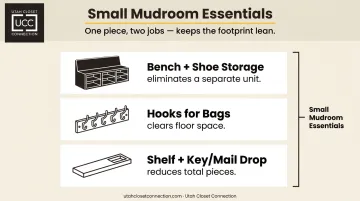
Each element that handles two jobs keeps the footprint lean without sacrificing function.
Seasonal and Boot Storage Tips for Utah Homes
Utah winters create a storage challenge that most generic mudroom advice ignores: tall boots. Knee-high shafts typically run 13.5–17.75 inches per DSW's boot sizing classifications, and over-the-knee styles start at 18 inches — well beyond what a standard 5-inch cubby can accommodate.
Planning for Tall Boots
When designing or selecting a mudroom system for Utah households, plan at least one floor-level zone with sufficient vertical clearance for tall boots to stand upright. A dedicated boot rack — designed to hold boots upright or inverted on posts — keeps them from flopping over and speeds up drying between uses.
The Seasonal Rotation Strategy
Keep only the current season's footwear accessible in the mudroom. Store off-season shoes in labeled bins or boxes in a bedroom closet or storage area. Seasonal rotation alone can noticeably reduce mudroom clutter — no extra shelving required.
Boot Drying Solutions
Wet boots are a recurring winter reality for Utah families coming in from skiing, snowshoeing, or a slushy commute. Two practical options:
- Inverted boot racks let boots stand upside down on posts, drawing airflow through the interior to speed drying
- Heated boot dryers run on low wattage (PEET's Original uses 36 watts) and dry most boots in 4–8 hours, with broad material compatibility including leather, rubber, neoprene, and canvas
Research published in a 2021 peer-reviewed review found that in-shoe humidity can reach 96–100%, creating conditions favorable to bacterial and fungal growth. Drying boots thoroughly before storing them in enclosed compartments is the most effective way to prevent odor buildup.
When Custom Built-In Storage Makes the Biggest Difference
Off-the-shelf solutions work well for many households. But when a mudroom has awkward dimensions, serves a large family, or needs to look like a designed part of the home rather than a furniture assembly project, custom built-ins deliver results that standard products can't match.
What Custom Mudroom Storage Can Include
A custom system is built around the exact footprint of your space:
- Cubby dimensions sized to your household's specific footwear — including tall-boot zones with correct clearance
- Integrated bench seating at ergonomic height
- Hooks positioned at both adult and child heights
- Upper cabinetry for backpacks, sports gear, and overflow storage
- A mix of open and closed storage designed around visibility from adjacent rooms
- Durable finishes selected for a high-traffic environment
For Utah homeowners looking for this level of customization, Utah Closet Connection has been designing and installing custom storage systems since 1983, with over 50 years of combined team experience. Their process is straightforward:
- Free in-home or virtual consultation
- Personalized design review with edits before anything is built
- Professional installation by licensed contractors, backed by a lifetime workmanship warranty

One client, Caroline B., described the process: "From the very beginning my designer made the whole process very easy and personal... the installers put blankets down in all the areas they were working, ensuring that no harm came to my home."
Utah Closet Connection serves Salt Lake, Utah, Davis, Summit, and Weber Counties, with estimates typically delivered within one to two weeks of initial contact. Reach their team at (801) 939-3088 (Monday–Thursday, 9AM–4PM) or request a consultation at utahclosetconnection.com.
Frequently Asked Questions
How do I store shoes in a mudroom?
Start with a boot tray or mat at the entry point, then add a dedicated storage system: cubbies, a storage bench, or a tiered rack. Size the system to hold only the current season's most-used pairs per person.
How can I store a lot of shoes when space is limited?
Go vertical with wall-mounted racks or floating shelves stacked up the wall. Apply the "current pairs only" rule so the mudroom holds active footwear only. Over-the-door organizers add capacity without using any floor or wall space.
What is the best shoe storage for a small mudroom?
A storage bench with built-in cubbies or drawers is the strongest single-piece solution — it combines seating and storage in one footprint. Add a wall-mounted rack above it when you need more capacity without expanding the floor area.
Should I use open or closed shoe storage in my mudroom?
Open storage (cubbies, shelves, baskets) makes it easier for everyone to put shoes away consistently. Closed storage (cabinet doors, lift-top benches) keeps the room looking tidier. For most households, the answer is both — open for daily-use shoes, closed for everything else.
How do I keep my mudroom from smelling like shoes?
Avoid fully sealed storage for everyday shoes — airflow matters. Allow wet boots and shoes to dry completely before placing them in enclosed compartments. Shoe deodorizers with activated carbon have research support; a 2021 review confirms that reducing in-shoe humidity is the most effective way to limit bacterial growth that causes odor.