
The main variables are closet type, square footage, materials, design features, and whether you hire a professional or go the DIY route. This guide breaks down realistic pricing tiers, the cost drivers that matter most, what gets left out of most budgets, and how to approach the project without overspending.
Key Takeaways
- Reach-in closets typically cost $1,200–$5,000; walk-ins run $5,000–$10,000; boutique master closets can reach $20,000+
- Material choice and drawer/door count are the biggest cost levers within any tier
- Professional installation reduces rework and delivers measurable returns at resale
- Budget separately for prep work — demo, drywall, electrical — which base quotes routinely exclude
- NARI's 2025 Remodeling Impact Report estimates 83% cost recovery for closet renovations
How Much Does a Custom Closet Cost?
Custom closets don't have a fixed price. Costs shift based on closet type, size, layout complexity, materials, and accessories. Knowing what drives those costs helps you budget for what you actually need — without overpaying for features you won't use.
According to Fixr's 2025 custom closet cost data, the national average range runs $2,500–$5,000, with a low end near $1,200 and a high end reaching $20,000 for luxury builds. Here's how that breaks down by closet type.
Reach-In Closets
Typical range: $1,200–$5,000
Reach-ins are the entry-level option — compact, single-wall or double-wall configurations found in bedrooms, hallways, and kids' rooms. At the lower end, you get basic shelving, a hanging rod, and minimal accessories. Moving toward $5,000 adds drawers, better finishes, and built-in shoe storage. These work well when floor space is limited and storage needs are straightforward.
Walk-In Closets
Typical range: $5,000–$10,000
Walk-ins offer real design flexibility. This tier accommodates multiple hanging zones, drawer banks, upgraded finishes, integrated lighting, and purpose-built storage sections. Utah Closet Connection's floor-to-ceiling walk-in configurations start at $5,000, with complexity and material upgrades pushing costs higher. This is also where dedicated sections — shoes, accessories, folded items — start making a measurable difference in daily use.
Master / Boutique Closets
Typical range: $10,000–$20,000+
At this level, you're building a dedicated dressing room. Fixr's 2025 data cites a $20,000 example for a 100-sq.-ft. boutique walk-in with wood veneer, motorized accessories, and a center island. Features at this tier include glass-front cabinetry, vanity stations, chandelier or recessed lighting, floating storage walls, and full dressing-room layouts. Best suited for large primary suites or bedroom-to-closet conversions.
Key Factors That Affect the Cost of a Custom Closet
Custom closet pricing is shaped by four main variables: the size and type of closet, material selection, design features, and installation method. Understanding each one helps you identify where your budget is going — and where you have room to adjust.
Closet Type and Size
More square footage means more materials and more labor. Fixr reports pricing of $17–$50 per square foot and $150–$450 per linear foot for installed systems. Even within the same closet type, a more complex layout — L-shaped vs. straight, multi-zone vs. single wall — adds cost.
Material Selection
Material choice has a major impact on the final number. Here's how installed costs per linear foot break down by material type (Fixr, 2025):
| Material | Installed Cost per Linear Foot |
|---|---|
| Laminate | $125–$150 |
| Melamine | $135–$175 |
| MDF | $140–$240 |
| Plywood | $150–$500 |
| Cedar | $200–$500 |
| Natural wood veneer | $200–$1,200 |
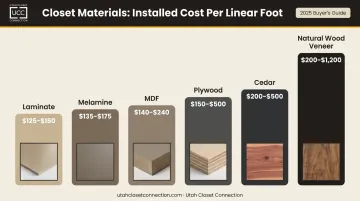
Laminate and melamine offer smooth, cleanable surfaces at a lower price point, while plywood and cedar hold up better over time. Natural wood veneer sits at the top of the range — and the gap between laminate and veneer can easily double the material cost of a project.
Design Features and Accessories
Every add-on carries a price. Common accessory costs based on Bob Vila's 2022 data:
- Drawers: $80–$200 each
- Shoe rack: $50–$75
- Jewelry organizer: $75–$150
- Closet island: $1,000–$2,500
- Lighting: $50–$2,000 depending on type
Sensor lighting runs $200–$500; under-cabinet or vanity lighting $300–$600; recessed lighting $800–$2,000. The number and complexity of drawers and door profiles are among the most impactful choices — more drawers mean significantly more cost.
Installation Method and Labor
Wall-hung systems (suspended off the floor) generally cost less to install than floor-mounted systems, which require more structural work but deliver a true built-in appearance. Bob Vila reports:
- Wall-mounted: $140–$240 per linear foot
- Floor-mounted: $200–$330 per linear foot
Labor runs $60–$90 per hour for professional closet installers, or is sometimes quoted as a flat project fee. Electricians — if lighting circuits are involved — run $50–$100 per hour separately.
Prep and Site-Specific Costs
These costs are frequently excluded from base quotes but can add meaningfully to your total:
- Demo of existing shelving or built-ins: Often required before new installation can begin
- Drywall patching: Needed after removing old systems
- Electrical work for new lighting circuits: Billed separately; in Salt Lake City, the municipal fee schedule includes a $59 base permit fee plus a 1% Utah state surcharge (Salt Lake City Building Services)
- Disposal of old materials: May or may not be included depending on the installer
Ask your installer which of these are included in the quoted price before you sign anything.
Full Cost Breakdown: What You're Actually Paying For
The quoted price rarely reflects the complete project cost. Here's a clearer picture of each component.
| Cost Component | What It Covers | Key Note |
|---|---|---|
| Materials & Cabinet System | Panels, shelving, rods, drawer boxes, and structural components | Switching from laminate to wood veneer on a mid-sized walk-in can add $2,000–$5,000 to this line alone |
| Labor & Installation | Design, measurement, fabrication coordination, and physical installation | Floor-mounted multi-zone layouts take longer and cost more; experienced installers reduce costly rework |
| Prep Work & Add-Ons | Demo, wall repair, lighting, and specialty accessories — billed separately from the base system | Always ask for an itemized breakdown before signing off on a quote |
| Ongoing Maintenance | Periodic hardware tightening, surface cleaning, and occasional adjustments | Custom closets are genuinely low-maintenance; a lifetime workmanship warranty covers defects and installation errors |
Working with licensed installers — like the team at Utah Closet Connection — matters most on the labor line. Mis-measured or improperly mounted systems require expensive rework that rarely shows up in the original quote.
Low-Cost vs. High-Cost Custom Closets: What's the Real Difference?
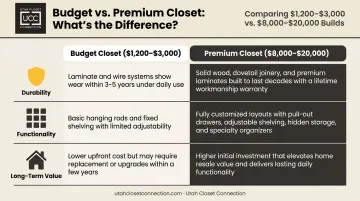
Both budget and premium custom closets address disorganization — but the difference shows up every time you use them. Material durability, configuration flexibility, and long-term value vary significantly across price tiers.
| Dimension | Budget ($1,200–$3,000) | Premium ($8,000–$20,000) |
|---|---|---|
| Durability | Entry-level laminates can chip or warp within 5–10 years | Commercial-grade boards and solid wood hold up for decades |
| Functionality | Limited configuration options; basic storage | Purpose-built zones for shoes, jewelry, seasonal items |
| Long-term value | May need full replacement in under a decade | Premium installs with warranties often last the life of the home |
On the ROI side, NARI's 2025 Remodeling Impact Report estimates 83% cost recovery for closet renovations — meaning a $5,000 project returns roughly $4,150 in perceived home value, according to NARI member estimates. That's not a guaranteed return, but for Utah homeowners thinking about resale, it's a meaningful signal — storage quality consistently ranks among the features buyers notice during walkthroughs.
Choosing the right tier comes down to how long you plan to stay in the home, how heavily the space will be used, and whether features like built-in lighting or pull-out hardware would genuinely improve your daily routine — not just look good on a showroom floor.
How to Budget Smartly for Your Custom Closet
The right budget is determined by intended use, not just price preference. A reach-in for a guest room has very different requirements than a master suite overhaul.
Simple decision framework:
- List must-have features vs. nice-to-haves
- Set a firm ceiling budget before you talk to anyone
- Request itemized quotes so you can see exactly where cuts are possible
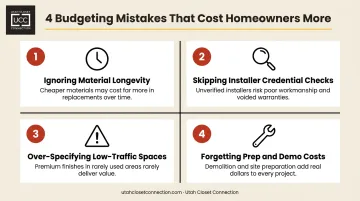
The four most common budgeting mistakes:
- Focusing only on the upfront cost, ignoring how long the materials will actually last
- Choosing the cheapest option without checking installer credentials or warranty terms
- Over-specifying premium features for low-traffic spaces (an island in a guest room closet, for example)
- Failing to budget for prep work, demo, or electrical before the first quote arrives
Once you know what to avoid, the next step is getting an accurate number to work with. Utah Closet Connection offers a free design consultation where you can review your space, discuss your goals, and walk away with a transparent, itemized estimate — typically within 1–2 weeks. As licensed contractors with a lifetime workmanship warranty, they can also flag any prep costs upfront so nothing catches you off guard when the project starts.
Frequently Asked Questions
How much does a closet renovation cost with professional installation?
Professional closet installation — including design, materials, and labor — typically runs $1,200 to $10,000+, depending on closet type and scope. Reach-ins start near the lower end; large walk-ins with premium finishes push toward the higher range or beyond.
Is it cheaper to build or buy a closet?
DIY and modular systems cost less upfront — often $300–$1,500 — but typically lack the precise fit, durability, and design integration of a custom install. The higher upfront cost of professional installation generally pays off through better longevity and stronger resale value.
Do closet upgrades increase home value?
Yes. NARI's 2025 data estimates roughly 83 cents returned per dollar spent on closet renovations. Primary closets are among the top features buyers prioritize, making organized storage a legitimate selling point in Utah's housing market.
What is the cheapest custom closet option?
A basic reach-in closet with laminate shelving and standard hanging rods is the most affordable starting point — typically $1,200–$2,500 professionally installed for a standard 6-foot configuration.
How long does it take to install a custom closet?
On-site installation ranges from 8 hours for a simple reach-in to one or two full days for a large walk-in. End-to-end project timelines — including design, fabrication, and scheduling — commonly run 3–5 weeks from design sign-off to installation day.
Does a custom closet installation require a permit?
In Salt Lake City and Greater Salt Lake MSD jurisdictions, standard closet installations typically don't require a permit. Adding or altering electrical circuits — such as installing new lighting — does trigger permit requirements. Working with licensed contractors ensures the work meets local code either way.