
Introduction
Picture a spare bedroom that's half home office, half guest room, and fully cluttered. A desk crowds one corner, a bed hogs the rest, and neither function works well. Then the bed folds into the wall, and suddenly the room breathes again.
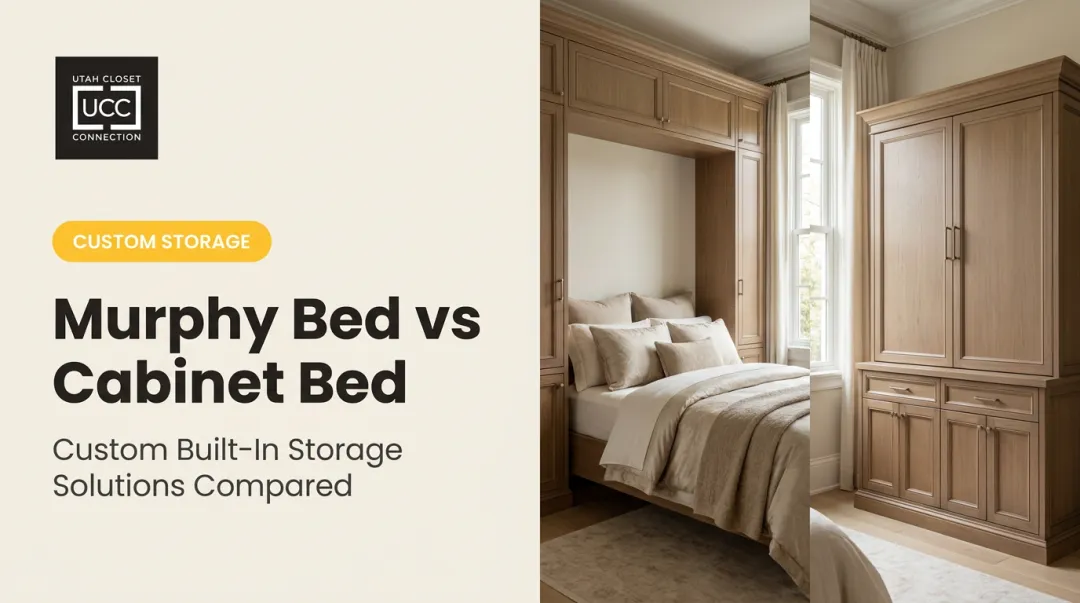
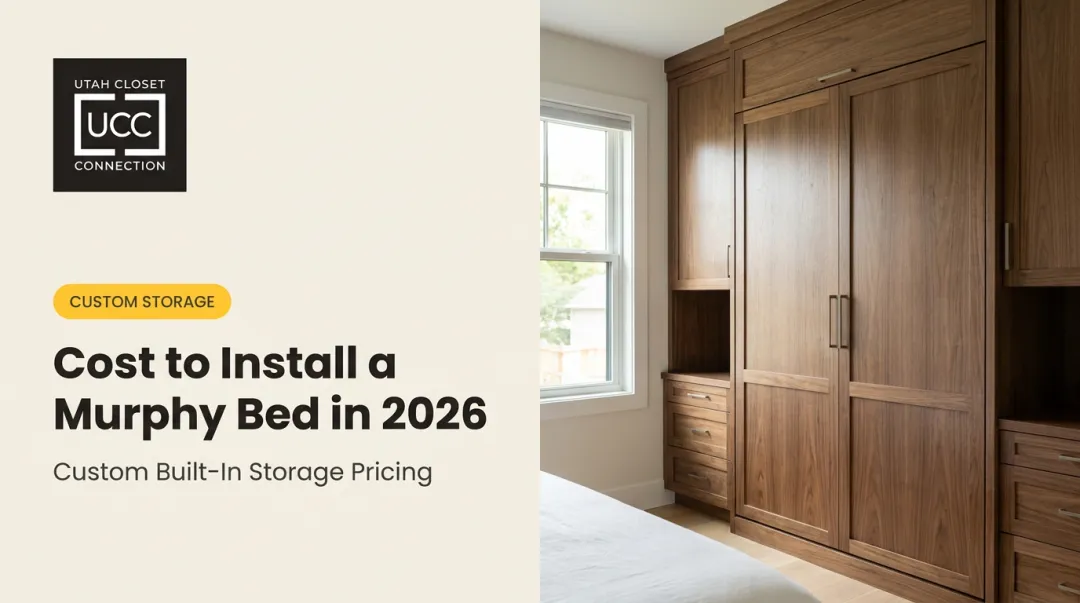
That's the appeal driving new interest in Murphy beds and wall beds. These aren't the wobbly, spring-loaded contraptions your grandparents worried about. Modern versions pair a quality mattress platform with built-in desks, sofas, shelving, and storage cabinets, turning one wall into a room that does double duty.
This guide covers what a Murphy bed actually is and why Utah homeowners are installing them. You'll also learn what to check before buying, whether custom or ready-made makes more sense, and how long a well-built unit should last.
Key Takeaways
- Murphy beds free up rooms for offices, gyms, or guest space without a permanent bed footprint
- Clearance, mattress thickness, and lift mechanism quality matter more than price alone
- Solid wood frames with piston mechanisms typically outlast particleboard models by a wide margin
- Custom builds fit irregular rooms and match existing cabinetry; ready-made kits cost less upfront
- Professional installation isn't optional for wall-mounted units, since improper mounting can cause the bed to detach from the wall
What Is a Murphy Bed (and How Is It Different From a Wall Bed)?
The name comes from William L. Murphy, who filed a patent for a "disappearing bed" on April 3, 1911, with the patent officially granted the following year. His design let a full bed pivot through a wall opening, freeing the floor space beneath it.
It's a solution over a century old, which says something about how persistent this space problem is.
Today, "Murphy bed" and "wall bed" get used interchangeably by most retailers and homeowners. There's a traditional distinction, though it's more historical convention than industry standard:
- Murphy beds traditionally used metal frames with spring-loaded lift systems
- Wall beds traditionally used wood frames paired with gas-piston mechanisms
- Many manufacturers today simply use the terms as synonyms, regardless of construction method
How the Mechanism Actually Works
Regardless of what you call it, the concept is the same. The bed frame hinges to a wall or cabinet system. When not in use, it folds up vertically (or occasionally horizontally) and locks flush against the wall, revealing the floor space it was covering.
Springs or pistons counterbalance the mattress weight so one person can lift or lower the bed without strain.
Why Homeowners Are Choosing Murphy Beds and Wall Beds
The math is simple: a spare room with a permanent bed is a spare room that can only be a bedroom. Fold that bed away, and the same square footage becomes an office, a workout space, or a den five days a week.
Multifunctionality is the bigger draw for most buyers. Newer designs pair the bed with:
- Fold-down desks that create a functioning home office
- Sofa units that convert a living room into a guest suite
- Bookshelves or cabinet storage flanking the bed frame
- Built-in charging stations or reading lights
This matters more now that remote and hybrid work are permanent fixtures. Federal labor data shows 35% of employed people did some or all of their work from home on days they worked in 2023, up from 24% in 2019, according to the Bureau of Labor Statistics. A room that's an office by day and a guest room by weekend solves a real scheduling problem.
The Utah Angle
Residential lots keep shrinking nationally, and Utah is no exception. Salt Lake City, Provo, and Park City all permit accessory dwelling units under 800 square feet in many zones, and new construction increasingly favors efficient footprints over sprawling floor plans. A well-designed wall bed lets a smaller home, condo, or ADU function like a larger one. In a 900-square-foot condo, for example, a single room can rotate from bedroom to home office to workout space across a single week.
There's also a resale angle. A thoughtfully built, professionally installed wall bed reads as a built-in amenity, similar to a custom closet system, rather than a piece of furniture a buyer has to work around.
What to Consider When Buying a Murphy Bed
Buying a Murphy bed involves more decisions than picking a finish color. Get these details wrong and you'll end up with a bed that's awkward to use or unsafe to operate.
Measure More Than the Mattress
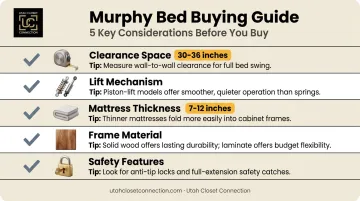
Don't just measure the mattress footprint. You need clearance on every open side, including walking space, door swing, and ceiling fixtures. Manufacturer guidance commonly recommends 30 to 36 inches of clearance around an open bed.
One popular full-size model extends nearly 85 inches from the wall when fully open. Check the specific model's open dimensions against your room, not a generic estimate.
Lift Mechanism: Springs vs. Pistons
- Spring-based systems mount coiled springs to the side panels and have been the traditional standard for decades
- Gas-piston systems use charged cylinders to counterbalance the bed, and many piston designs include a locking leg that prevents the bed from lowering until both support legs are raised
- Manufacturers describe piston systems as smoother and easier for one person to operate, though there's no independent test confirming one type universally outlasts the other
Either system should let you raise and lower the bed with one hand. If it takes real effort, that's a sign of poor calibration for your mattress weight.
Mattress Thickness and Compatibility
Most Murphy bed frames are built around mattresses between 7 and 12 inches thick, though this varies significantly by model. Weight allowance runs from roughly 60 to 90 pounds. Thicker mattresses fold more awkwardly and can strain the lift mechanism. Toppers and pads typically need to be removed before folding, so factor that into your daily routine.
Frame Materials and Durability
Solid wood and multi-layer plywood cost more upfront but hold up to repeated folding far better than particleboard or MDF. Manufacturers that use plywood construction point to better strength and stability under the constant stress of daily lift cycles. Beyond the wood itself, check the joinery and hardware. Steel brackets and reinforced hinge points matter more than screw count, and mounting hardware should be rated for the bed's full weight, not just the frame.
Safety Features Worth Prioritizing
Certain safety features deserve priority regardless of mechanism type:
- Locking mechanisms that prevent the bed from lowering accidentally
- Anti-pinch or soft-close hardware, especially in households with kids or pets
- A cabinet lock if the bed doubles as a decorative piece when closed
Custom-Built vs. Ready-Made Murphy Beds: Which Is Right for Your Home?
This decision usually comes down to how standard your room is and how much you want the bed to look like it belongs there rather than sitting in it.
Ready-made or boxed Murphy beds work well when:
- You need something installed quickly
- Your room has standard dimensions
- Budget is the primary constraint
- You're comfortable with limited finish choices
These typically ship flat-packed for assembly. Installing it yourself is possible, but it demands time, tools, and careful attention to the manufacturer's mounting instructions.
Custom-built wall beds make more sense when:
- Your room has an odd angle, low ceiling, or nonstandard width
- You want the bed cabinet to match existing trim, paint, or cabinetry
- You're combining the bed with a desk, shelving, or a sofa in one built-in system
- You want a seamless look rather than a standalone box against the wall
This is where Utah Closet Connection fits into the picture. As a custom cabinetry company operating since 1983, the team builds the surrounding cabinetry, storage, and finish work around a wall bed system so it reads as part of the room's architecture, not an add-on.
Every project starts with a free design consultation, and all work carries a lifetime workmanship warranty, the same standard applied to their closet and built-in cabinet installations.
There's also a middle path. Semi-custom options let you personalize finishes, hardware, or storage add-ons without paying for a fully bespoke build. This route offers more flexibility than a boxed unit without requiring every dimension to be custom-fit.
How Long Do Murphy Beds Last?
The honest answer: it depends heavily on what the bed is made of and how it's used.
| Material | Typical Lifespan | Why It Varies |
|---|---|---|
| Solid wood frames with quality hardware | 10–15+ years | Well-maintained units can last decades; some installations from the 1970s still function today |
| Particleboard or MDF models | About 5 years | Hinges loosen and panels start to sag under repeated folding |
Lifespan comes down to two factors more than anything else: hardware quality and usage frequency. A bed folded daily in a busy household wears differently than one used occasionally for guests. Manufacturer cycle testing on premium mechanisms often exceeds 10,000 open-close cycles, but that's a lab number, not a guarantee for your specific unit.
Maintenance Tips to Extend the Life of Your Bed
- Inspect mounting hardware every few months: check that wall brackets and bolts haven't loosened from repeated use
- Don't exceed the weight limit: overloading strains the lift mechanism faster than normal daily folding
- Lubricate moving parts per the manufacturer's schedule, not on a random guess
- Address squeaks or resistance early: a mechanism that's suddenly harder to lift is telling you something
Professional Installation: Why It Matters
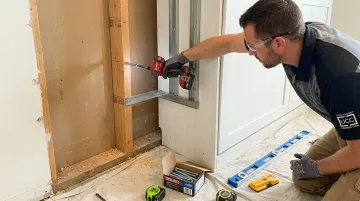
Murphy beds are heavy, often requiring both wall and floor anchoring, and the mounting instructions are more involved than typical furniture assembly. This isn't a project to guess your way through.
Recent recalls confirm the risk is real:
- The Consumer Product Safety Commission recalled roughly 129,000 wall beds in the U.S. after reports of beds detaching from the wall, including one death and dozens of injuries.
- A separate 2024 recall covered more than 69,000 additional units for the same crush hazard.
In both cases, professional inspection or reinstallation was part of the remedy.
Correct installation into wall studs, not just drywall anchors, is the difference between a bed that stays put and one that doesn't.
Utah Closet Connection's licensed contractors handle installation across Salt Lake, Utah, Davis, Weber, and Summit counties, mounting the bed securely and finishing the surrounding cabinetry to match the rest of the room. That combination of structural know-how and finish work is hard to replicate with a DIY install.
Frequently Asked Questions
What to consider when buying a Murphy bed?
Focus on available space and clearance (30-36 inches around the open bed), lift mechanism quality, mattress compatibility, frame material, and safety features like locking mechanisms. Skipping any of these leads to a bed that's uncomfortable or unsafe to use daily.
What is the average lifespan of a Murphy bed?
Solid wood models with quality hardware typically last 10 to 15 years or more, while particleboard versions tend to last around 5 years. Hardware quality and how often the bed is folded both play a major role.
What's the difference between a Murphy bed and a wall bed?
The terms are largely interchangeable today. Traditionally, Murphy beds used metal frames and spring mechanisms, while wall beds used wood frames and gas pistons, but most retailers no longer draw that distinction.
Can I install a Murphy bed myself, or do I need a professional?
Some ready-made kits allow DIY assembly, but wall-mounted models are heavy and require secure anchoring into wall studs. Given the safety risks of improper mounting, professional installation is the safer choice.
What size mattress works best with a Murphy bed?
Most frames accommodate mattresses 7 to 12 inches thick; thinner options fold more easily and put less strain on the lift mechanism. Always confirm the exact height limit with your specific model's manufacturer.
How much does a custom Murphy bed cost compared to a ready-made one?
Ready-made options are generally more budget-friendly upfront but limited in sizing and finish. Custom builds cost more but deliver tailored dimensions, matched finishes, and integration with your home's existing storage. Utah Closet Connection designs and installs custom Murphy bed cabinetry backed by a lifetime workmanship warranty, with estimates typically ready in 1-2 weeks.