The good news? A tight closet doesn't have to mean tight storage. With the right systems, a modest 3x4-foot space can hold nearly as much as a walk-in. And 2026 is bringing smarter layouts, sustainable materials, and clever tech-friendly tricks to make it happen.
This guide covers decluttering, vertical storage, shoe and accessory solutions, multi-functional furniture, budget DIY hacks, and how to know when it's time for a custom closet build.
Key Takeaways
- Vertical space, hanging doors, and nearby furniture help small closets function like walk-ins
- Editing your wardrobe before organizing is the single most impactful, free first step
- Mixing open storage for daily items with closed bins keeps small closets tidy
- Budget DIY hacks double capacity short-term, but custom systems maximize space long-term
Start Smart: Decluttering and Planning Before You Organize
Before you buy a single bin or shelf bracket, grab a tape measure. Measure your closet's width, depth, and height. Most reach-in closets run 4 feet wide with 24 to 30 inches of depth, but plenty of older homes fall well short of that, especially on depth. Buying organizers before you know your exact dimensions is the fastest way to waste money on products that don't fit.
Edit, Then Inventory What's Left
Here's a rule that works: if you haven't worn something in six months, it's time to decide whether it stays, goes to donation, or moves to off-site storage. This isn't just decluttering advice for its own sake.
Fewer items means less competition for the same limited square footage. Research summarized by the American Psychological Association found that among roughly 1,600 adults surveyed, greater clutter was associated with more stress and lower life satisfaction. Less stuff genuinely feels better, not just tidier.
Once you've thinned things out, group what's left:
- Hanging garments (shirts, dresses, pants)
- Folded knits and sweaters
- Shoes
- Accessories (belts, scarves, jewelry)
Sorting by category before shopping for organizers means you design around your actual needs, not a generic "one-size-fits-all" kit that leaves half your closet unused.
Maximize Every Inch with Vertical Storage
Most small closets waste the area above eye level. That unused space, often two or three feet of empty air near the ceiling, is where you'll find your biggest capacity gains with a custom-designed system.
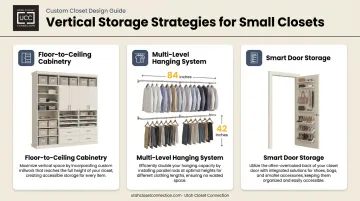
Utilize Floor-to-Ceiling Cabinetry
Instead of leaving empty space, a custom closet system uses built-in shelving and cabinetry that extends to the ceiling. This creates dedicated storage for out-of-season items, luggage, or labeled bins, keeping less-used articles accessible but out of the way.
Create a Multi-Level Hanging System
A double- or even triple-hang rod system can instantly multiply your capacity. A professional designer can configure rods at optimal heights—like one at 84 inches for shirts and another at 42 inches for pants—to fit your specific wardrobe.
This strategy frees up valuable wall space for integrated drawers or shelving, a feature standard builder closets often lack.
Integrate Smart Door Storage
The back of a closet door is prime real estate. Rather than using temporary over-the-door organizers, a custom solution can incorporate built-in, full-length racks for shoes, scarves, or accessories, turning an empty surface into functional storage.
Smart Storage Solutions for Shoes, Accessories, and Folded Items
Vertical space solves capacity. But small closets also need a mix of open storage for things you grab daily and closed storage for everything else. Without that mix, clutter piles up on the floor fast.
Solve the Shoe Storage Struggle
Shoes eat space disproportionately in small closets. A few fixes:
- Clear stacking shoe bins or space-savers that double shelf capacity
- A basket "bouquet," several small baskets grouped together, for sandals and flip-flops
- Over-the-door racks, which typically hold anywhere from 10 to 36 pairs depending on the style
Use Bins, Baskets, and Drop-Front Boxes
Labeled bins or drop-front boxes keep folded sweaters, out-of-season clothing, or bags contained. They also create a flat surface on top for extra display or overflow. Clear-front bins let you spot contents at a glance, so you're not opening every box just to find one sweater.
Add Shelf Dividers for Stacked Items
Clear or wire shelf dividers keep stacks of jeans, sweaters, or towels from toppling. This one small addition prevents that "avalanche every time you grab something" problem. Custom closet designs, like those built by Utah Closet Connection, often build dividers directly into the shelving so they never shift or need replacing.
Create a Jewelry and Accessory Station
Small felt-lined trays, a jewelry tree, or a few wall hooks keep necklaces and belts from getting lost in bins or tangled into a knot you'll fight with later. A shallow drawer insert works especially well for rings and earrings that easily slip between larger items.
Upgrade to Slimline Hangers
Swap bulky mismatched hangers for matching slim velvet or wooden ones. This single change can free up two to three inches of rod space, letting you fit noticeably more without crowding.
Multi-Functional Furniture and Layout Tricks
Multi-Functional Storage and Layout Tricks
When there's genuinely no room left inside the closet, borrow function from what's nearby.
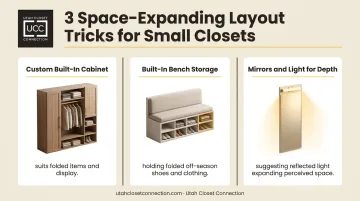
Add a Custom Built-In Cabinet Nearby
A custom-built cabinet or wardrobe unit near the closet handles folded items and doubles as a display surface for a mirror or jewelry tray, without relying on generic furniture.
Build In Bench Storage Near the Closet
A custom-built bench with hidden storage, sized to fit an odd nook near the closet, holds off-season clothing and extra shoes without added clutter.
Use Mirrors and Light to Create Depth
Custom mirrored closet doors, paired with tap lights or LED strips, make a cramped closet feel bigger and far easier to see into. Architectural Digest notes that mirrored surfaces can create the illusion of a larger space by drawing the eye past the actual wall and reflecting more light around the room.
DIY Budget Hacks vs. Investing in a Custom Closet System
Should you spend a weekend with a drill, or call in a design team? It depends on your closet's shape, your timeline, and how long you plan to live with the result.
Try These Budget-Friendly DIY Wins First
For under $50 and an afternoon, you can knock out:
- A shelf-and-bracket combo ($15-30) for quick extra storage
- A wire shelving kit for adjustable, low-cost shelving
- An over-the-door organizer for shoes or accessories
These are legitimate wins, especially for renters or anyone testing a layout before committing to something permanent.
Know the Limits of DIY Systems
Pre-fab wire shelving and stacked bins work fine short-term, but they have limits:
- Sag or bow over time under heavy loads
- Look cluttered once you've added five different bin brands
- Struggle with awkward corners, slanted ceilings, or odd nooks that don't match standard kit dimensions
If your closet has any irregular angles, a boxed kit probably won't use the space efficiently.
When to Call in a Professional Design Team
For an irregularly shaped or heavily used small closet, a custom-built system is the long-term answer. Instead of forcing a generic kit into an odd space, a designer measures your exact closet and builds around it, corners, slants, and all.
Utah Closet Connection has been designing custom storage across Salt Lake, Utah, Davis, Weber, and Summit Counties since 1983. For a small closet project, that typically means:
- A free design consultation, either in-person at their South Salt Lake location or on-site
- Custom closet designs scaled to your size, layout, and material choices
- A design estimate delivered in 1-2 weeks, so it's realistic even for smaller remodeling budgets
- Installation by licensed contractors, backed by a lifetime workmanship warranty
For homeowners in Sandy, Provo, Bountiful, Ogden, or anywhere else in the service area who are tired of re-organizing the same 4x4 space every year, that's the difference between a temporary fix and a closet that actually works for good.
Frequently Asked Questions
What are some ideas for small closet design?
Start by decluttering, then stack hanging rods to create two hanging zones. Add floor-to-ceiling shelving for vertical space, and use labeled bins to keep folded items contained and visible.
How can I organize a very small closet on a budget?
Try low-cost DIY wins first: a $15-$30 shelf-and-bracket kit, an over-the-door organizer, and slimline hangers. Together these can increase capacity for under $50.
Where should I store shoes in a small closet?
Use clear stacking shoe bins to double shelf capacity, a basket "bouquet" for sandals and flip-flops, and an over-the-door rack for everyday pairs you grab often.
What is considered a small closet, and how much can it actually hold?
A typical reach-in closet runs about 4 feet wide with 24 to 30 inches of depth, though older homes often measure shallower. Smart systems can boost functional capacity well beyond raw square footage.
How much does a custom closet system cost in Utah?
Costs vary based on size and materials, but custom designs generally start around $5,000. Utah Closet Connection offers a free consultation and a 1-2 week estimate to get an accurate number for your specific space.
How do I store out-of-season clothes when I don't have room?
Labeled bins on a high shelf, under-bed storage containers, or vacuum-sealed bags are all solid options for rotating seasonal items without taking up everyday closet space.